
A fascinating anomaly is currently unfolding in the crypto market. Even as regulatory scrutiny tightens globally, a select group of privacy coins is recording significant value appreciation.
This phenomenon presents a clear paradox. On one hand, the world is moving toward total surveillance where financial anonymity seems impossible. On the other hand, the market demand for genuine privacy is becoming louder than ever.
In practice, the illusion of anonymity on standard blockchains is easily shattered. Rapid advancements in blockchain analytics tools, such as those developed by Arkham or Chainalysis, allow specific parties to track and cluster transaction patterns.
The biggest vulnerability lies with Centralized Exchanges (CEX). Mandatory Know Your Customer (KYC) procedures effectively link real-world identities to specific wallet addresses. Once that connection is made, an individual’s entire transaction history, balance, and investment activity become an open ledger.
This is the core of the issue. Many crypto users argue that while transparency at the system level is necessary, absolute transparency at the individual level is highly undesirable.
For most investors, the idea that anyone can view their balances and history is deeply uncomfortable. It is essentially the same as posting our bank account details and asset portfolios for the public to see. The implications go beyond comfort; they involve real personal security. Public knowledge of someone’s wealth can endanger that individual and their family.
The need for privacy is even more critical at the institutional scale. A financial institution or major corporation cannot operate on a fully transparent blockchain. Their entire list of counterparties, transaction volumes, and strategic asset accumulations would be easily identified by competitors.
This not only destroys competitiveness but also makes it impossible for them to meet existing regulatory requirements, particularly those regarding customer data confidentiality. This is one of the main reasons why many banks and large financial institutions remain hesitant to fully enter the crypto ecosystem. They have not yet found assurance that customer privacy can be adequately protected.
Monero (XMR): The Gold Standard of Absolute Privacy
When discussing privacy coins, all roads lead to one name: Monero (XMR). Launched in 2014, Monero is not just a legacy player. It has become the primary benchmark used to measure the success of all other privacy projects.
Its decade-long existence proves its resilience. Throughout its journey, Monero has been the prime target for anyone attempting to break blockchain anonymity. From analytics firms armed with sophisticated tools to various government agencies, many have tried to penetrate its defenses. Remarkably, Monero has successfully maintained user privacy to this day.
Monero operates on a Proof-of-Work (PoW) consensus mechanism, meaning it is mined just like Bitcoin. However, there is a fundamental difference. Monero utilizes an algorithm specifically designed to be ASIC-resistant.
ASICs are expensive hardware chips built for a singular purpose, such as calculating SHA-256 hashes for Bitcoin. Standard chips can never compete with them. In contrast, the Monero algorithm is intentionally complex and constantly changing to make ASIC processing inefficient. This design allows anyone with a standard CPU to participate in mining.
The result is a level of network decentralization that theoretically exceeds Bitcoin, where mining is now dominated by heavily capitalized entities.
Monero’s privacy edge does not rely on a single trick. Instead, it utilizes three layers of technology that work in unison and remain “always on” for every transaction:
- Stealth Addresses: This feature protects the recipient. When you send XMR, the transaction is not routed to the receiver’s public address. Instead, the protocol automatically generates a unique one-time address for that specific transaction which is accessible only by the intended recipient.
- Ring Signatures: This protects the sender. When an individual signs a transaction, their digital signature is mixed with several random user signatures from the blockchain. Consequently, outside observers can verify the transaction is valid, but it is nearly impossible to pinpoint the actual sender.
- Ring Confidential Transactions (RingCT): This hides the transaction amount. On the Bitcoin blockchain, everyone sees “Wallet A sent 1.5 BTC to Wallet B.” In Monero, the ledger only shows “Wallet A sent XMR to Wallet B.” The exact amount remains hidden from the public.
Regarding performance, Monero features a unique dynamic block size design. Blocks can expand dynamically as needed when network traffic spikes. Because of this capability, Monero claims the ability to handle high volumes, theoretically reaching up to 2,000 transactions per second (TPS). At a glance, this rivals Visa’s transaction processing throughput.
However, there is a trade-off. Transaction finality ranges between 20 to 40 minutes. Monero developers state this is the necessary cost for the multi-layered cryptographic security they deploy.
The economic model is also distinct. After the first 18 million XMR were mined in its first six years, Monero shifted to a “tail emission” phase in 2022. In this phase, 0.6 new XMR is created in every mined block forever. This means Monero does not have a fixed maximum supply. The objective is to ensure miners remain incentivized to secure the network indefinitely while maintaining a stable and permanently low inflation rate.
Zcash (ZEC) and the Philosophy of Optional Privacy
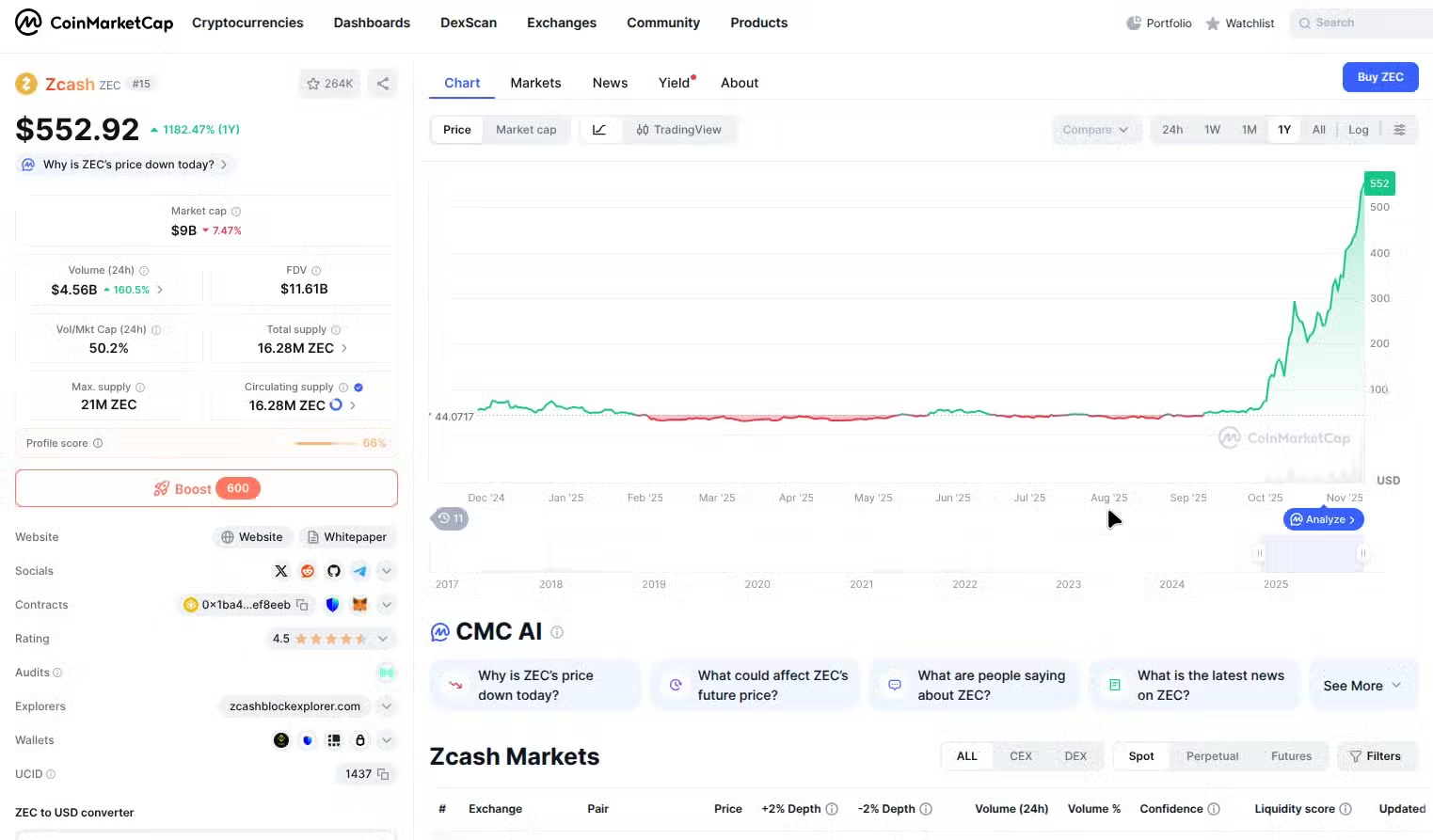
While Monero represents non-negotiable absolute privacy, Zcash (ZEC) introduces a fundamentally different approach. Launched in 2016, Zcash is effectively a fork of Bitcoin. Its primary objective was to engineer a more private version of Bitcoin while retaining core characteristics like the 21 million maximum supply cap.
Zcash also utilizes a Proof-of-Work (PoW) mechanism via the Equihash algorithm. Initially, Zcash was designed to be mined with standard computers which mirrored Monero’s decentralization philosophy. However, this commitment shifted in May 2018 when Bitmain released specific ASIC miners for Zcash.
Since that pivot, mining Zcash requires expensive specialized hardware. This decision effectively alienated home miners and has arguably reduced its degree of decentralization.
The most fundamental divergence between Zcash and Monero lies in their operational philosophies. Privacy on Monero is always active and mandatory. Privacy on Zcash is optional. Users can select their desired level of privacy for each specific transaction.
This flexibility is made possible through two distinct address types:
- T-Addresses (Transparent): These function exactly like Bitcoin addresses. All transaction details, including the sender, receiver, and amount, are fully visible on the public blockchain.
- Z-Addresses (Shielded): These utilize Zcash’s core technology known as zk-SNARKs. When transactions involve Z-Addresses, the transaction details are obfuscated.
The combination of these addresses creates a spectrum of flexibility. If a transaction occurs between two T-Addresses, it is 100% public. If a sender uses a Z-Address to pay a T-Address, the public sees only the recipient and amount. Conversely, if a T-Address sends to a Z-Address, the public knows only the sender. Full privacy occurs only when both the sender and receiver utilize Z-Addresses. In this scenario, the transaction is completely private.
Technologically, the Zcash privacy implementation is highly sophisticated and has not been successfully breached by blockchain analytics firms or governments. Yet, ironically, the vast majority of transactions on the Zcash network remain public.
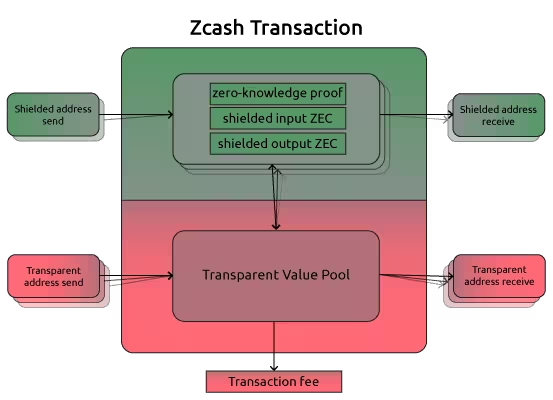
This strategic weakness is not a technological failure but the result of external factors. Most Centralized Exchanges (CEX) bound by KYC regulations do not support deposits or withdrawals using Z-Addresses. They only permit transactions to transparent T-Addresses. This creates a massive barrier to the adoption of its core privacy features.
One key feature designed by Zcash that fundamentally distinguishes it from Monero is “viewing keys.” This feature allows Z-Address owners to voluntarily grant read-only access to third parties, such as auditors or tax authorities, without surrendering control of their funds.
This is the true DNA of Zcash. It was not designed to be “dark money.” Instead, it functions as a system of “auditable privacy” or “compliant privacy.”
The Regulatory Dilemma and Real-World Use Cases
All technological advantages possessed by privacy coins ultimately serve as a double-edged sword. Their ability to obfuscate transaction trails is the primary differentiator that gives them value, yet that very capability strikes fear into regulators worldwide.
These regulatory concerns are well-founded. From a government perspective, absolute financial privacy is ideal for illegal activity. Privacy coins can significantly facilitate Money Laundering (AML), tax evasion, and terrorist financing.
Want Sharper & Deeper Market Analysis?
Get exclusive insights that are logical, comprehensive, and unbiased. Start building your investment strategy based on data, not just assumptions.
Furthermore, these assets potentially fuel black market activities ranging from narcotics trade to the sale of stolen data. While a criminal kingpin in the past struggled to hide large amounts of physical cash, privacy coins offer a tracking solution that is nearly impossible to penetrate. The technology behind Monero and Zcash has proven unbreakable for years when used correctly.
Due to these concerns, privacy coins face intense regulatory pressure. One of the most damaging impacts for investors is the wave of delistings from major Centralized Exchanges (CEX) like Binance and OKX.
For exchanges, this is purely a business and compliance decision. To operate legally, they must adhere to Anti-Money Laundering regulations and enforce KYC. Privacy coins are inherently in conflict with these mandates so delisting often becomes the only viable option.
However, associating privacy coins purely with criminality is a myopic view. There are many legitimate and essential use cases:
- Personal Security: As discussed earlier, many high-net-worth individuals are uncomfortable having their financial history and total wealth exposed to the public. This is not just about privacy but risk prevention. Someone known to hold large crypto assets can become a target for extortion or physical crime. This risk extends to their families.
- Business Protection: Corporations operating on the blockchain need to protect sensitive information. They cannot allow competitors to view their supplier lists, payment volumes, or the destination of strategic fund flows.
The most technically compelling use case is the role of privacy coins as an anonymity layer for transparent blockchains like Bitcoin. The Bitcoin blockchain is a public ledger. If someone knows your Bitcoin address, they can view every transaction you have ever received or sent, along with your current balance. Even moving funds to a fresh wallet leaves a clear trail.
This is where privacy coins serve to “break the link of traceability.” Let us dissect the “Atomic Swap” mechanism (BTC > XMR > BTC):
- Step 1: A user holds 1 BTC in a public wallet (Wallet ABC). A blockchain analyst can see this balance. The user then employs an Atomic Swap service via a Decentralized Exchange to swap that 1 BTC for roughly 50 XMR into a new Monero wallet (Wallet XYZ).
- Step 2: In the eyes of the blockchain analyst, the trail is visible up to a point: “Wallet ABC sent 1 BTC to a swap address.” Once funds enter the Monero network at Wallet XYZ, the trail goes cold. The analyst can no longer see what happens to those 50 XMR.
- Step 3 (Critical): If the user immediately swaps the 50 XMR from Wallet XYZ back to a new Bitcoin wallet, an analyst might still suspect a correlation based on timing and amount.
- Step 4 (The Solution): To sever the trail completely, the user must perform “mixing” or “churning” within the Monero network. They send the 50 XMR from Wallet XYZ to several other internal Monero wallets (e.g., Wallet DEF and GHI). Because transactions on Monero are private, this internal movement is untraceable.
- Final Result: When the user finally swaps XMR from their last Monero wallet (Wallet GHI) to a fresh Bitcoin wallet, it is nearly impossible for anyone to prove the BTC in the new wallet originated from Wallet ABC. The Bitcoin transaction history has been effectively “cleaned.”
The Middle Path to Adoption: ZK-SNARKs and the Era of Compliant Privacy
The potential for privacy coins is undeniably compelling. As more of the population moves online, the demand for financial privacy will likely surge. However, if privacy coins want to evolve from speculative instruments into widely adopted technology, they cannot remain at war with regulators forever. They must find a “middle ground.”
The most painful lesson regarding this reality comes from the Tornado Cash case. Tornado Cash was not a coin but a decentralized mixer protocol on the Ethereum network. It allowed users to deposit assets and withdraw them to a different wallet effectively severing the transaction trail.
In August 2022, the US Treasury Department (OFAC) imposed heavy sanctions on the protocol. They placed it on the blacklist making it illegal for any US person to use it. The website was seized, the GitHub account was frozen, and one of the developers was even arrested.
Although the sanctions were eventually overturned in November 2024 (with a ruling that software code itself cannot be sanctioned), the damage was already done. This case proves that absolute uncompromising privacy will always collide violently with state institutions.
This is where the technological “middle path” becomes essential. The solution will likely stem from the implementation of Zero-Knowledge Proofs, specifically those known as ZK-SNARKs.
The core concept of Zero-Knowledge is simple: “I will prove to you that I know a secret without telling you what that secret is.”
ZK-SNARK is one of the most efficient implementations of this concept. “SNARK” stands for Succinct Non-Interactive Argument of Knowledge:
- Succinct: The mathematical “proof” generated is tiny. It is often just a few kilobytes and is extremely fast to verify.
- Non-Interactive: The best part is that the prover (you) does not need back-and-forth interaction with the verifier (the regulator). You simply generate one small “proof” file, send it, and their system can instantly validate it.
How does this technology create “compliant privacy” for AML/KYC? Let us examine the following scenario:
Imagine you want to use a Decentralized Exchange (DEX). Regulators demand that the DEX can only be used by people who are (A) not from a sanctioned country and (B) not on a terrorist watch list. How do you prove these two facts without uploading your ID and home address to the blockchain?
The solution is “selective disclosure” using ZK-SNARKs:
- Verify Once: You visit an accredited institution (like your bank) and privately show your ID.
- Proof Generation: The bank does not send your ID data. Instead, they run a ZK-SNARK program that generates a small “proof” file. This proof mathematically states: “I have verified the owner of wallet 0x123. I guarantee they are NOT from a sanctioned nation and NOT on a terrorist list.”
- Proof Usage: You go to the DEX. When prompted, you submit only that ZK-SNARK “proof” file.
- Result: The DEX system verifies the proof in a split second and grants access. The regulator is satisfied because AML/KYC compliance is achieved. You are satisfied because no one knows your name or where you are from.
It is crucial to understand that this utilizes ZK-SNARKs for IDENTITY Privacy (Personal Data). This is a sector currently being developed by projects like Polygon ID. This differs slightly from the use of ZK-SNARKs by Zcash where the primary focus is TRANSACTION Privacy (Money).
Monero vs. Zcash: The Battle of Future Visions
From the extensive analysis above, we finally arrive at the core question. Which privacy model will survive and thrive in the future? Is it Monero’s absolute privacy or Zcash’s compliant optional privacy?
There is no debate that Monero is the mature and established benchmark for blockchain privacy. It offers robust, decentralized, and always-on privacy. However, this “no compromise” philosophy acts as its greatest limitation. From a legal compliance standpoint, Monero represents a significant challenge for regulators.
It offers no “backdoors” for unauthorized access and provides no mechanism for auditing. Consequently, Monero will likely continue to face regulatory pressure and exchange delistings. It will be perpetually pushed into more restricted market niches.
This is where Zcash presents a completely different vision.
Even though the adoption of its privacy features (Z-Addresses) is currently low due to exchange barriers, the Zcash design is fundamentally more future-proof. Zcash offers the “middle ground.”
It accommodates regulatory needs in two ways. First, the existence of transparent T-Addresses allows exchanges to comply with KYC/AML rules. Second, through “viewing keys,” users—especially institutions—can voluntarily grant audit access to authorities like tax offices without sacrificing their privacy from the public or competitors.
If we assume the financial future is not black and white, and not a choice between total transparency or total crime, then the technology capable of balancing both will hold the greatest competitive advantage.
Monero represents absolute financial privacy. Zcash competes to become “compliant financial privacy.”
For example, an individual may wish to hide their salary details from neighbors and colleagues by using Z-Addresses yet remains willing to report that income to the tax office using a viewing key. Monero cannot accommodate this scenario. Zcash can.
Therefore, if the future of crypto adoption—especially by institutions and financial bodies—depends on the ability to coexist with global legal frameworks, the Zcash model is theoretically far superior. Technology that possesses a middle ground between meeting individual privacy needs and public compliance almost always creates a clearer path for long-term adoption.
Disclaimer: The content provided by corequil.com is for information and education purposes only and is not intended as investment or financial advice. Please do your own research (DYOR) as your actions are your own responsibility. Check the Terms and Conditions for more information.