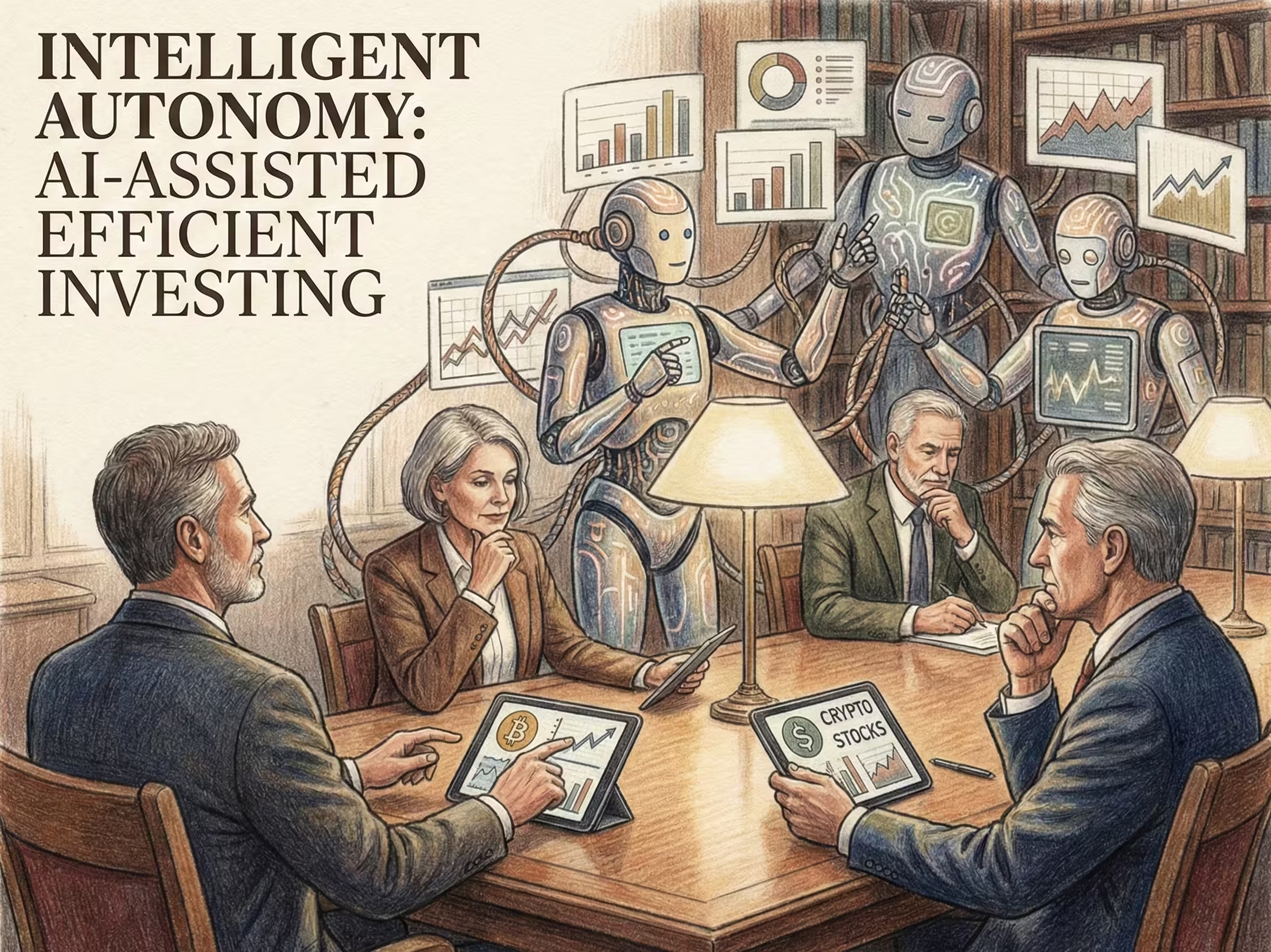
The Quantum Paradox: Why Legacy Banking Is More Vulnerable Than Bitcoin
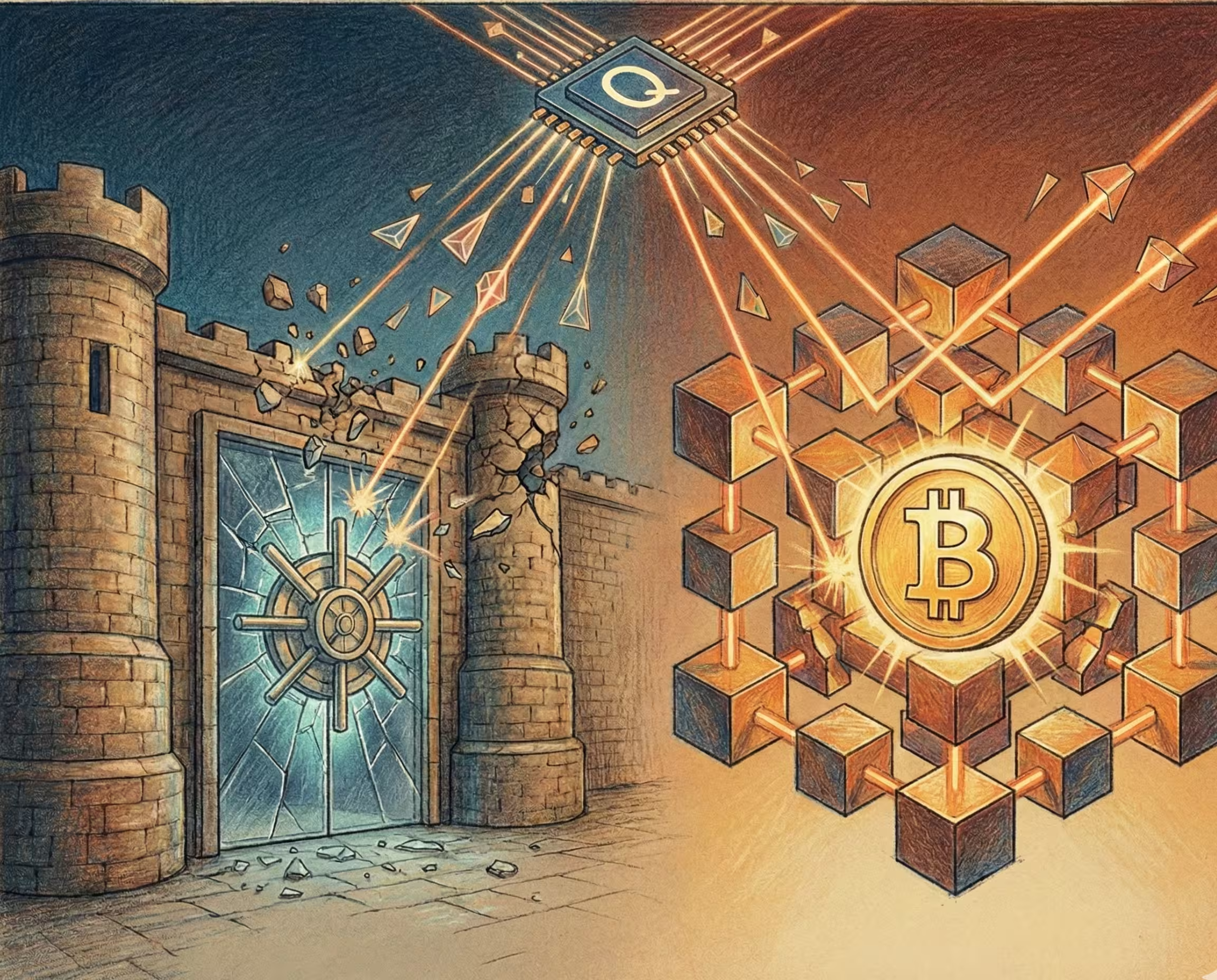
ANATOMI OF A PANIC: DECONSTRUCTING THE “QUANTUM APOCALYPSE” FALLACY Mass hysteria is often a byproduct of technical illiteracy. In the digital asset cycle, the “Quantum Apocalypse” narrative is a perennial ghost story; it resurfaces every time Google or IBM announces a laboratory breakthrough. The narrative is simple, viral, and lethal to weak hands: “Quantum computers will process data so fast they will derive your Private Key in seconds, sending $1.4 trillion in market cap to zero.” This thesis is fundamentally flawed. To understand the true risk profile—and why institutional giants like BlackRock and Fidelity maintain their exposure—we must dismantle this myth at the level of particle physics. The issue is not speed; the issue is probability. BEYOND BINARY: THE PHYSICS OF PROBABILITY The primary error among retail observers is viewing a quantum computer as a “Turbo” version of a classical machine. They imagine a classical computer is a race car, while a quantum computer is a rocket. This analogy is dangerously misleading. Classical computers (binary) operate deterministically. They process information in bits: 0 or 1. Picture a mouse navigating a maze; it tries one path, hits a wall, returns, and tries another. It operates linearly and sequentially. Quantum computers operate on different physics. Utilizing a principle of quantum mechanics known as Superposisi, the processing unit (Qubit) exists as 0, 1, or both simultaneously. Returning to the maze analogy: a quantum computer does not send a single mouse. It floods the entire maze with water instantly. The water locates the exit immediately because it occupies all possible paths at the same time. In cryptography, this means a quantum machine does not “guess passwords rapidly” (classic brute force). Instead, it utilizes specific algorithms to collapse the mathematical structure protecting the key. However, this weapon is not universal. We must distinguish between two mathematical vectors: Shor’s Algorithm and Grover’s Algorithm. THE SNIPER: SHOR’S ALGORITHM AND THE ASYMMETRIC VULNERABILITY This is the genuine existential threat, though its timeline is widely misunderstood. Bitcoin’s security—and the security of the global banking layer—relies on Asymmetric Cryptography, specifically Elliptic Curve Cryptography (ECC) on the secp256k1 curve. The premise relies on a “Trapdoor Function”: it is computationally trivial to multiply two large prime numbers to generate a Public Key, but thermodynamically impossible for a classical computer to reverse that operation to derive the Private Key. Shor’s Algorithm, when executed on a sufficiently powerful quantum machine, solves this Discrete Logarithm Problem efficiently. If Shor’s Algorithm functions perfectly with adequate Qubit capacity, it reduces the complexity of breaking the key from exponential to polynomial. Effectively, the mathematical firewall protecting Bitcoin signatures could be breached. This is a “Sniper” targeting the transaction signature mechanism. Yet, as we will explore, Bitcoin possesses a defensive layer that banking SSL certificates lack: Hashing. THE BRUTE: WHY GROVER’S ALGORITHM FAILS AGAINST SHA-256 Mainstream media frequently conflates quantum algorithms. Grover’s Algorithm operates on entirely different mechanics and poses a negligible threat to the Bitcoin network. Grover is designed for unstructured database searches. In the context of digital assets, it attacks the SHA-256 (Secure Hash Algorithm) function used for mining and address generation. The reality: Grover’s Algorithm only provides a “Quadratic Speedup,” not the exponential jump seen in Shor’s. Translated to encryption security standards: Grover effectively halves the security bits of symmetric encryption. Is SHA-128 insecure? Practically, SHA-128 remains impenetrable. Cracking it via brute force would require energy output exceeding that of our sun. Consequently, the narrative that “Bitcoin Mining is dead” or “Hashing is broken” is mathematical fiction. Furthermore, if the threat from Grover accelerates, the remediation is trivial: Bitcoin executes a Soft Fork to upgrade to SHA-512, instantly restoring full security margins. THE NOISE BARRIER: THE “WILLOW” CHIP AND THE REALITY OF LOGICAL QUBITS Why has the network remained secure despite Google announcing the “Willow” quantum chip with 105 Qubits? There is a massive divergence between Physical Qubits (produced by Google/IBM) and Logical Qubits (required to run Shor’s Algorithm). Physical Qubits are notoriously volatile. They suffer from decoherence—loosing their quantum state due to microscopic heat or cosmic radiation. To execute complex calculations like deriving a Private Key, we require Logical Qubits that are stable and possess error-correction capabilities. Current consensus among physicists is stark: To create 1 Logical Qubit, we require between 1,000 and 10,000 Physical Qubits working in unison strictly to correct errors. To break Bitcoin’s secp256k1 encryption, rough estimates suggest we need 2,000 to 4,000 Logical Qubits. Multiplied by the error correction ratio, the hardware requirement swells to millions of Physical Qubits. Today, we are in the hundreds, operating with high error rates (the NISQ Era – Noisy Intermediate-Scale Quantum). Scaling from 100 to 1,000,000 is not a software update; it is an engineering challenge comparable to the moon landing. The gap between “theoretically possible” and “industrially capable” is separated by decades of innovation in materials science and cryogenics. “Q-Day” is not an event for tomorrow morning; it is a slowly moving horizon. THE ARCHITECTURE OF IMMUNITY: BITCOIN’S DOUBLE-VAULT STRUCTURE If one assumes Bitcoin’s security relies on a single layer of “unbreakable” encryption, they have failed their technical due diligence. The most common error in retail analysis is the assumption that a Bitcoin Address is identical to a Public Key. This represents a fundamental misunderstanding of the protocol’s defense-in-depth architecture. To understand why even a functional quantum computer would hit a mathematical wall when attempting to seize assets, we must dissect the two pillars of the protocol: The Elliptic Curve (ECDSA) and the Hashing Shield. THE GLASS DOOR: ECDSA AND THE STRUCTURAL VULNERABILITY We must first address the legitimate vulnerability; the vector most cited by bear cases. The heart of Bitcoin’s digital signature scheme is the ECDSA (Elliptic Curve Digital Signature Algorithm), specifically utilizing the secp256k1 curve. The mechanism operates as a classic trapdoor function: This is where Shor’s Algorithm becomes relevant. If an attacker possesses your Public Key, a quantum computer with sufficient Logical Qubits (in the thousands) could theoretically reverse this operation. The algebraic structure of elliptic curves is susceptible to … Read more