The Quantum Paradox: Why Legacy Banking Is More Vulnerable Than Bitcoin
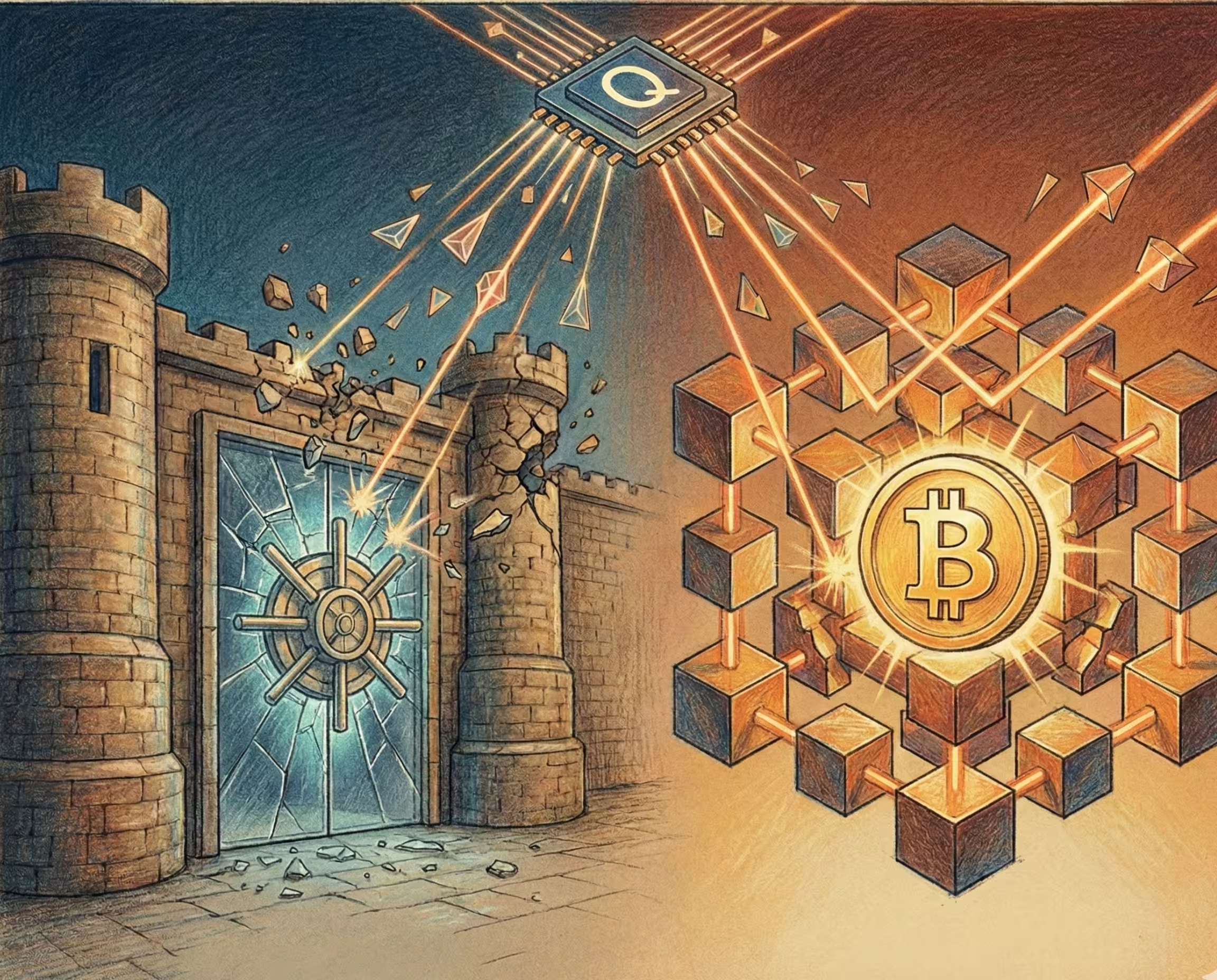
ANATOMI OF A PANIC: DECONSTRUCTING THE “QUANTUM APOCALYPSE” FALLACY Mass hysteria is often a byproduct of technical illiteracy. In the digital asset cycle, the “Quantum Apocalypse” narrative is a perennial ghost story; it resurfaces every time Google or IBM announces a laboratory breakthrough. The narrative is simple, viral, and lethal to weak hands: “Quantum computers will process data so fast they will derive your Private Key in seconds, sending $1.4 trillion in market cap to zero.” This thesis is fundamentally flawed. To understand the true risk profile—and why institutional giants like BlackRock and Fidelity maintain their exposure—we must dismantle this myth at the level of particle physics. The issue is not speed; the issue is probability. BEYOND BINARY: THE PHYSICS OF PROBABILITY The primary error among retail observers is viewing a quantum computer as a “Turbo” version of a classical machine. They imagine a classical computer is a race car, while a quantum computer is a rocket. This analogy is dangerously misleading. Classical computers (binary) operate deterministically. They process information in bits: 0 or 1. Picture a mouse navigating a maze; it tries one path, hits a wall, returns, and tries another. It operates linearly and sequentially. Quantum computers operate on different physics. Utilizing a principle of quantum mechanics known as Superposisi, the processing unit (Qubit) exists as 0, 1, or both simultaneously. Returning to the maze analogy: a quantum computer does not send a single mouse. It floods the entire maze with water instantly. The water locates the exit immediately because it occupies all possible paths at the same time. In cryptography, this means a quantum machine does not “guess passwords rapidly” (classic brute force). Instead, it utilizes specific algorithms to collapse the mathematical structure protecting the key. However, this weapon is not universal. We must distinguish between two mathematical vectors: Shor’s Algorithm and Grover’s Algorithm. THE SNIPER: SHOR’S ALGORITHM AND THE ASYMMETRIC VULNERABILITY This is the genuine existential threat, though its timeline is widely misunderstood. Bitcoin’s security—and the security of the global banking layer—relies on Asymmetric Cryptography, specifically Elliptic Curve Cryptography (ECC) on the secp256k1 curve. The premise relies on a “Trapdoor Function”: it is computationally trivial to multiply two large prime numbers to generate a Public Key, but thermodynamically impossible for a classical computer to reverse that operation to derive the Private Key. Shor’s Algorithm, when executed on a sufficiently powerful quantum machine, solves this Discrete Logarithm Problem efficiently. If Shor’s Algorithm functions perfectly with adequate Qubit capacity, it reduces the complexity of breaking the key from exponential to polynomial. Effectively, the mathematical firewall protecting Bitcoin signatures could be breached. This is a “Sniper” targeting the transaction signature mechanism. Yet, as we will explore, Bitcoin possesses a defensive layer that banking SSL certificates lack: Hashing. THE BRUTE: WHY GROVER’S ALGORITHM FAILS AGAINST SHA-256 Mainstream media frequently conflates quantum algorithms. Grover’s Algorithm operates on entirely different mechanics and poses a negligible threat to the Bitcoin network. Grover is designed for unstructured database searches. In the context of digital assets, it attacks the SHA-256 (Secure Hash Algorithm) function used for mining and address generation. The reality: Grover’s Algorithm only provides a “Quadratic Speedup,” not the exponential jump seen in Shor’s. Translated to encryption security standards: Grover effectively halves the security bits of symmetric encryption. Is SHA-128 insecure? Practically, SHA-128 remains impenetrable. Cracking it via brute force would require energy output exceeding that of our sun. Consequently, the narrative that “Bitcoin Mining is dead” or “Hashing is broken” is mathematical fiction. Furthermore, if the threat from Grover accelerates, the remediation is trivial: Bitcoin executes a Soft Fork to upgrade to SHA-512, instantly restoring full security margins. THE NOISE BARRIER: THE “WILLOW” CHIP AND THE REALITY OF LOGICAL QUBITS Why has the network remained secure despite Google announcing the “Willow” quantum chip with 105 Qubits? There is a massive divergence between Physical Qubits (produced by Google/IBM) and Logical Qubits (required to run Shor’s Algorithm). Physical Qubits are notoriously volatile. They suffer from decoherence—loosing their quantum state due to microscopic heat or cosmic radiation. To execute complex calculations like deriving a Private Key, we require Logical Qubits that are stable and possess error-correction capabilities. Current consensus among physicists is stark: To create 1 Logical Qubit, we require between 1,000 and 10,000 Physical Qubits working in unison strictly to correct errors. To break Bitcoin’s secp256k1 encryption, rough estimates suggest we need 2,000 to 4,000 Logical Qubits. Multiplied by the error correction ratio, the hardware requirement swells to millions of Physical Qubits. Today, we are in the hundreds, operating with high error rates (the NISQ Era – Noisy Intermediate-Scale Quantum). Scaling from 100 to 1,000,000 is not a software update; it is an engineering challenge comparable to the moon landing. The gap between “theoretically possible” and “industrially capable” is separated by decades of innovation in materials science and cryogenics. “Q-Day” is not an event for tomorrow morning; it is a slowly moving horizon. THE ARCHITECTURE OF IMMUNITY: BITCOIN’S DOUBLE-VAULT STRUCTURE If one assumes Bitcoin’s security relies on a single layer of “unbreakable” encryption, they have failed their technical due diligence. The most common error in retail analysis is the assumption that a Bitcoin Address is identical to a Public Key. This represents a fundamental misunderstanding of the protocol’s defense-in-depth architecture. To understand why even a functional quantum computer would hit a mathematical wall when attempting to seize assets, we must dissect the two pillars of the protocol: The Elliptic Curve (ECDSA) and the Hashing Shield. THE GLASS DOOR: ECDSA AND THE STRUCTURAL VULNERABILITY We must first address the legitimate vulnerability; the vector most cited by bear cases. The heart of Bitcoin’s digital signature scheme is the ECDSA (Elliptic Curve Digital Signature Algorithm), specifically utilizing the secp256k1 curve. The mechanism operates as a classic trapdoor function: This is where Shor’s Algorithm becomes relevant. If an attacker possesses your Public Key, a quantum computer with sufficient Logical Qubits (in the thousands) could theoretically reverse this operation. The algebraic structure of elliptic curves is susceptible to … Read more
The Great Decoupling: Why Bitcoin No Longer Fears The Fed

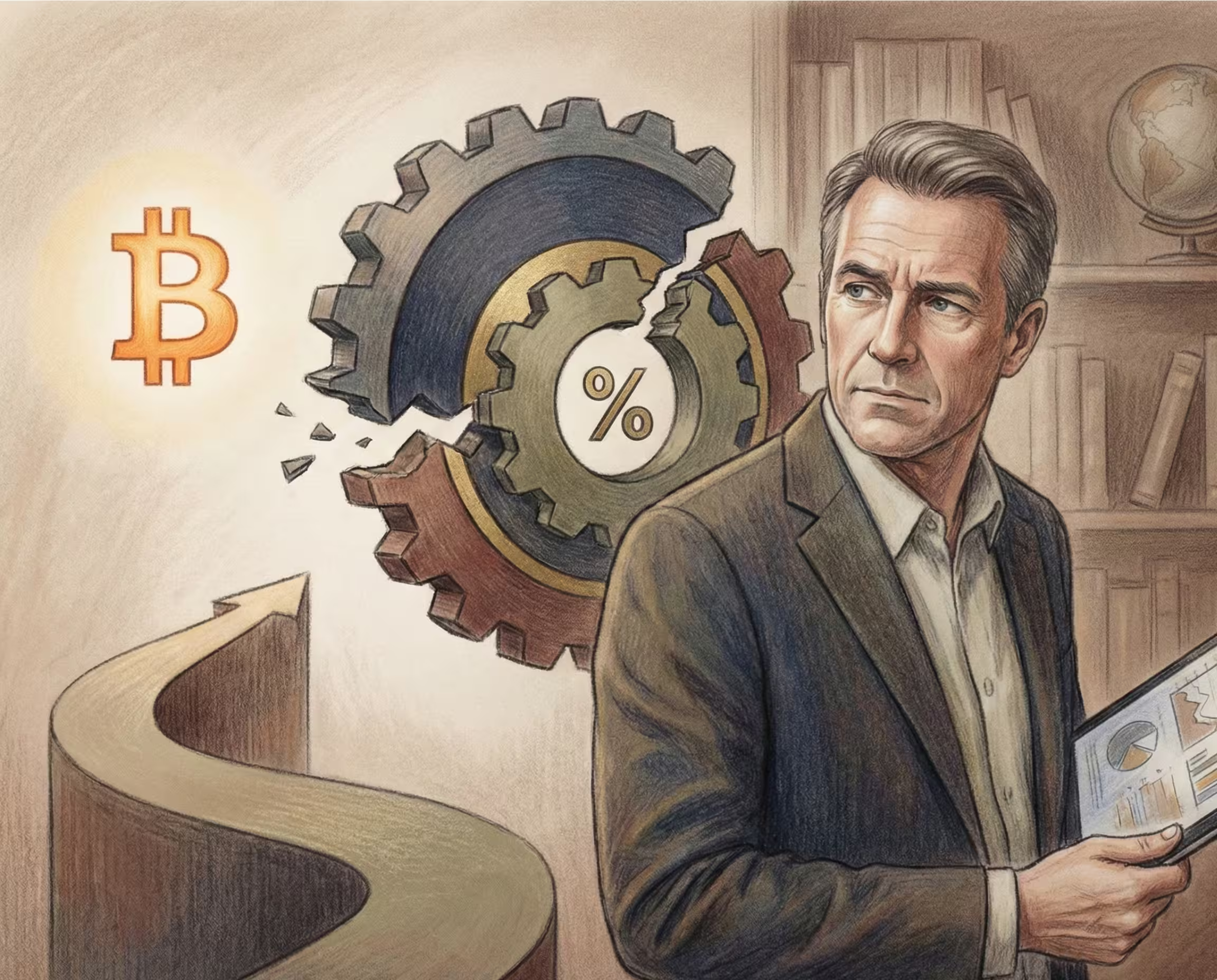
THE ILLUSION OF CORRELATION EXECUTIVE SUMMARY CHAPTER 1: The Pavlovian Trap (Behavioral Arbitrage) The digital asset market is currently suffering from a severe case of collective delusion. As of February 2026; Bitcoin has corrected to the $70,000 range; a drawdown exceeding 20% from local highs. The consensus reaction across the spectrum; from X (formerly Twitter) threads to paid signal groups; is uniform: “We need the Fed to cut rates to restore momentum.” This represents a fatal form of analytical complacency. Retail investors are exhibiting behavior akin to the subjects in Ivan Pavlov’s experiments: they hear the bell (Rate Cut news) and immediately salivate (Buy). They fail to recognize a critical shift in market structure: in 2026; the bell likely does not signify dinner. It signifies the opening of the abattoir. The Retail Delusion: Binary Thinking The primary vulnerability of the retail cohort is Binary Thinking. This logic held validity during the 2009-2021 epoch due to low inflation and manageable sovereign debt levels. However; applying a 2020 framework to the 2026 market environment is tantamount to capital destruction. The macro context has shifted from Monetary Dominance (Fed control) to Fiscal Dominance (Sovereign Debt/Deficit control). If the Federal Reserve cuts rates today; it is likely not a sign of victory over inflation. It indicates that a component of the banking system or the Treasury market has fractured. In a Hard Landing or Recession scenario; risk assets like Bitcoin do not rally. They are liquidated to cover margin calls in traditional equity and credit markets. Anticipating a rate cut without analyzing the catalyst for said cut is indistinguishable from blind gambling. Institutional View: Algorithmic Predation While retail participants refresh economic calendars awaiting CPI prints; Institutional Capital and High-Frequency Trading (HFT) firms are engineering traps. Institutions are indifferent to a 0.1% variance in CPI. Their primary focus is the location of your Liquidity (Stop Losses). The Institutional “Stop Hunt” Mechanism: At Corequil; we define this phenomenon as a “News-Based Liquidity Grab.” If your strategy relies solely on the economic calendar; you are not an investor; you are yield for the algorithms. The False Narrative: Historical Reality Check Let us examine the data. The narrative that “Fed Pivots always trigger Bull Runs” is a fallacy repeated until it mimics truth. Financial history reveals a more brutal reality. The following matrix compares market reactions to Rate Cuts across differing economic regimes: Era Rate Cut Catalyst Economic Condition Risk Asset Reaction (S&P 500 / BTC) Status 2000 (Dot Com) Equity Market Collapse Recession CRASH (-50%) post-Pivot Bear Trap 2007-2008 (GFC) Banking Crisis Systemic Recession CRASH (-57%) post-Pivot Bear Trap 2019 Global Slowdown Stable Rally (Pre-COVID) Normal 2020 (COVID) Pandemic External Shock V-Shape Recovery (Due to Massive QE) Outlier 2026 (Current) ??? Stagflation / Debt ??? High Risk Table Analysis:Observe the correlation in 2000 and 2008. The Fed cut rates aggressively; yet the market capitulated. The cause: those Rate Cuts were panic responses to a dying economy. In 2026; with Bitcoin correcting at $70k and prediction markets pricing in cuts; the critical inquiry is this: Is the Fed cutting because inflation is tamed (Bullish); or because the US Bond Market is facing a liquidity crisis (Bearish)? If the answer is the latter; the positive correlation between Bitcoin and Rate Cuts will decouple. We are entering uncharted territory where holding Cash carries risk parity with holding assets; yet relying on a Fed bailout is a hollow strategy. The 2020 playbook is obsolete. Burn it. CHAPTER 2: The “Broken” Money System (Diagnosis: Jeff Park) With the illusions of the previous cycle incinerated; we must now confront the structural decay of the engine itself: The Federal Reserve’s control console has been severed from the drivetrain. For the past forty years; Jerome Powell and his predecessors operated with a single; binary lever: Interest Rates. In 2026; this lever is no longer connected to the economic reality. The Monetary Transmission Mechanism has suffered a catastrophic failure. Jeff Park; Head of Alpha Strategies at Bitwise (formerly ProCap); is one of the few institutional voices articulating the unsaid reality: We are approaching the event horizon of “Positive Rho.” First Principles: The Dead Steering Wheel Why has the mechanism failed? The answer lies in the arithmetic of the US Sovereign Debt stack; which has now breached $38 Trillion. In a low-debt regime (circa 1980-2000); raising rates effectively drained liquidity. Borrowing costs surged; corporate expansion halted; consumption slowed; and inflation cooled. However; under the current regime of Fiscal Dominance; raising rates triggers a lethal paradox.The US Government is the world’s largest borrower. When the Fed hikes rates to 5%+; the Treasury is mathematically obligated to pay significantly higher interest expenses to bondholders. As of February 2026; the US pays over $1.5 Trillion annually solely in interest. This is not credit creation; this is fresh capital injection (deficit spending) flowing directly into the balance sheets of institutions and high-net-worth entities. The Consequence: The Fed attempts to brake the economy via hikes; yet the Treasury inadvertently sprays trillions in fiscal stimulus to asset holders. It is the monetary equivalent of attempting to extinguish a fire with gasoline. The “Positive Rho” Theory (Jeff Park’s Thesis) This paradox forms the core of Jeff Park’s thesis; potentially the “Holy Grail” or Endgame for Bitcoin. In derivatives finance; Rho ($\rho$) measures an option’s sensitivity to interest rate changes. Traditional risk assets typically exhibit “Negative Rho” (Rates Up -> Asset Prices Down). Park argues that Bitcoin is evolving into a Positive Rho Asset.In this paradigm; Bitcoin’s price appreciates in tandem with rising interest rates. The Mechanism: If you observe Bitcoin surging while Powell delivers a Hawkish press conference; do not view it as an anomaly. It is the market repricing Bitcoin as insurance against systemic fiat failure rather than a speculative tech proxy. Skeptic View: The Deflationary Abyss Intellectual honesty demands we stress-test this thesis. Will the transition to “Positive Rho” be linear? No. The primary risk is Timing.Before the fiscal money printer completely overrides the monetary brakes; we face the risk of … Read more

Wall Street Without Passports

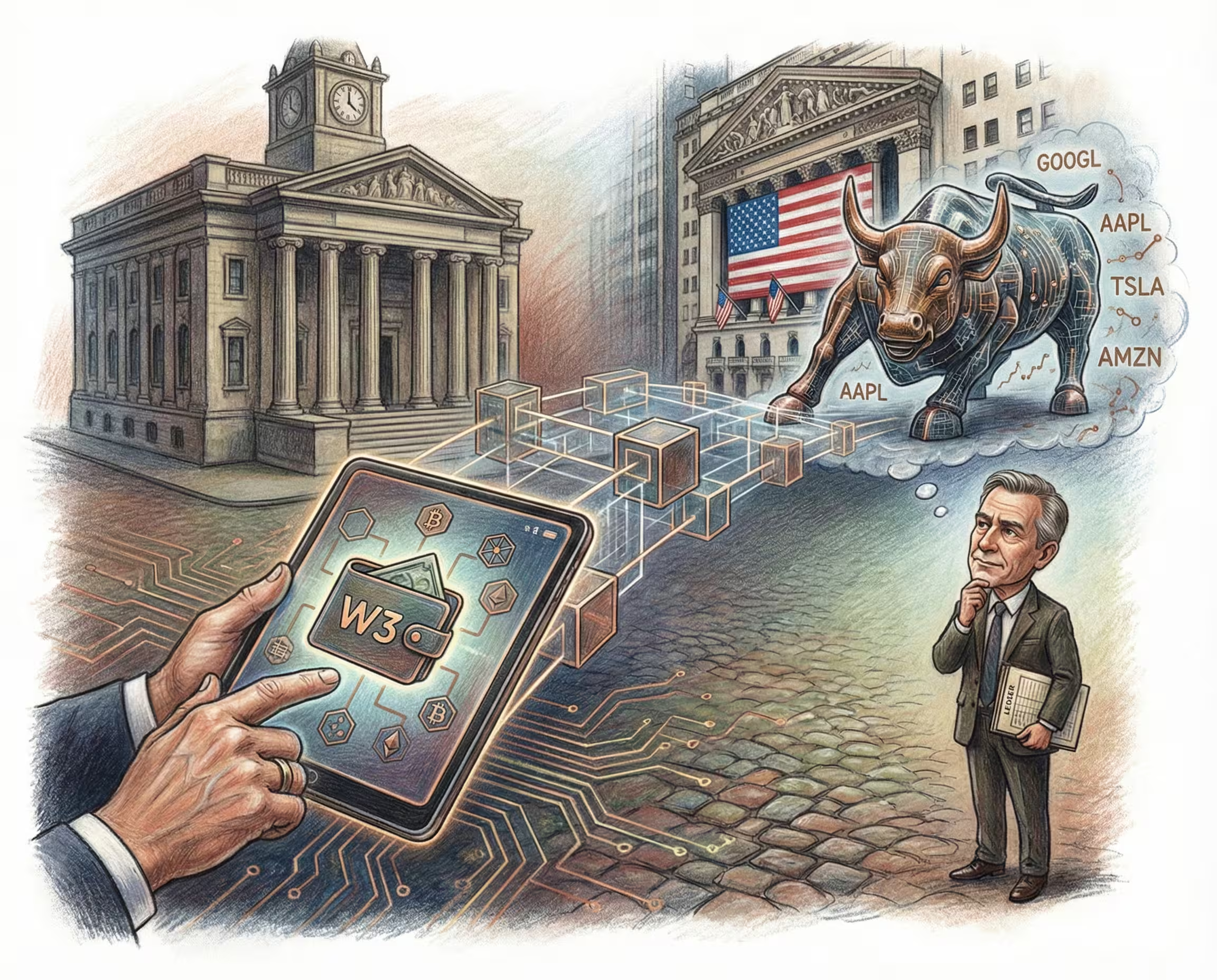
DISINTERMEDIATING WALL STREET: The Evolution of Web3 Equity Access CHAPTER 1: The Paradigmatic Shift From Key Storage to Global Investment Terminal The Death of the “Wallet” MonikerFor the past decade; the term “Wallet” has suffered from severe reductionism. The market viewed these tools merely as digital vaults for private keys; mechanisms to pay gas fees; or galleries for JPEG speculation. As of February 3, 2026; the integration of MetaMask and Ondo Global Markets fundamentally alters this paradigm. MetaMask is no longer just a wallet. It has evolved into a Hybrid Investment Terminal. Solving Liquidity FragmentationApplying first-principles analysis; this integration solves a critical inefficiency: Liquidity Fragmentation. Historically; a user required a bank account for fiat; a brokerage account for equities; and a Web3 wallet for crypto. These were three distinct silos with three compounding fee layers. Those barriers are now dismantling. Self-custodial wallets now possess capabilities equivalent to an institutional trading desk. Users can execute swaps from USDC directly into exposure against US mega-caps like Apple or Tesla; all without exiting the Ethereum ecosystem. The Attack on the Walled GardenThis represents a kinetic strike against the “Walled Garden” business model of legacy banking. If a non-custodial interface can hold Gold (PAXG); Cash (USDC); and Equities (Ondo GM); the bank’s utility as a “wealth gatekeeper” becomes obsolete. For investors in the Global South; traditionally isolated by prohibitive wire transfer fees; this is not merely convenience. It is unprecedented market access. The Institutional Thesis: Why Consensys Needs Wall Street Do not assume Consensys (MetaMask’s parent) is acting out of altruism. This is a data-driven calculation. While the crypto market capitalization is significant; it remains a rounding error compared to the $100 Trillion ocean of Traditional Finance (TradFi). The Growth Saturation ProblemThe architects at Consensys recognize a critical metric: User Saturation. Native crypto growth has plateaued. To achieve the next order of magnitude in scaling; the industry cannot rely on memecoin speculation or volatile yield farming. The ecosystem requires assets that are stable; trusted; and globally understood: US Equities and Treasuries. Joe Lubin’s team is deploying a “Trojan Horse” strategy. By admitting TradFi assets onto Ethereum rails; they effectively position blockchain as the Global Settlement Layer. Every stock purchase executed within MetaMask bypasses Wall Street commissions; instead; it generates gas fees for the network and swap fees for MetaMask. This is a hostile takeover of revenue streams; migrating value from legacy infrastructure to digital rails. Retail Psychology: The “Super App” Syndrome From a behavioral finance perspective; we are witnessing a shift from specialization to consolidation. The modern retail investor suffers from “App Fatigue.” Managing capital across local e-wallets; domestic brokerages; and crypto exchanges creates mental friction and capital inefficiency. Portfolio ConvergenceCapital demands Seamless Liquidity. Investors require the agility to capture Bitcoin upside during Asian trading hours and rotate immediately into S&P 500 ETFs during the NY session; all within a single interface. This drives “Portfolio Convergence.” Digital and physical assets are no longer distinct asset classes in the user’s mind. To the Gen Z and Millennial demographic; 1 Ondo GM Token is as valid as 1 share held at a custodian. The only difference is the ledger: a centralized SQL database versus a transparent global distributed ledger. The market is pricing in efficiency over tradition. CHAPTER 2: Dismantling the Barriers to Entry The Anatomy of Global Friction Theoretically; capitalism promises free markets. In practice; access to high-quality wealth creation instruments—specifically US Equity Markets—is restricted by “Geographic Lotteries.” An investor in Jakarta or Lagos faces friction that a New York resident does not. Legacy Banking architecture enforces a predator cost structure: The Cryptographic Solution: Atomic Settlement The value proposition of the MetaMask/Ondo integration is Atomic Settlement. In TradFi; equity settlement lags by T+1 or T+2 days. On-chain; settlement is finalized within the block time. Technically; this replaces expensive Correspondent Banking networks with efficient Smart Contracts: This aligns with the thesis of “Borderless Capital.” The protocol ignores nationality. It verifies only two variables: Solvency (wallet balance) and Sanctions Screening (OFAC). The Bear Case: Democratization or Liquidity Extraction? However; institutional risk analysis requires skepticism. We must look past the “Democratization” narrative and follow the liquidity flows. The Capital Flight ThesisWhen millions of emerging market users rotate from local assets (domestic equities; local bonds) into Tokenized US Treasuries; the macro effect is Capital Flight. Liquidity is siphoned from developing economies to finance US National Debt and inflate US Tech valuations. Regulatory Arbitrage & Sovereign RiskThere is a profound legal asymmetry: We are not witnessing pure financial freedom; we are observing a massive gray zone where technological efficiency outpaces consumer protection frameworks. CHAPTER 3: Technical Anatomy of Real World Assets (RWA) The Minting & Redemption Cycle The true innovation of RWA lies in the backend plumbing; not the UI. Understanding Ondo GM requires dissecting how a digital token forces the movement of a legal entity. This is Legal Transmutation. The Lifecycle of the Token: Note on Latency: There is a fundamental timing mismatch. Blockchain settles instantly; equity markets settle in T+2. Ondo bridges this gap by providing buffer liquidity; creating an “instant” user experience despite the lethargy of the underlying banking rails. Asset-Backed Assurance: The Oracle Problem The claim “1 Token = 1 Share” is dangerous without verification. This introduces The Oracle Problem: Blockchains are blind to the physical world. Unlike Bitcoin; where truth is endogenous (mathematical); RWA truth is exogenous. Trust is not eliminated; it is shifted. This is not a “Trustless” system; it is “Trust-Minimized.” You no longer trust a CEO’s word; but you must trust the Custodian’s integrity; the Auditor’s competence; and the Oracle’s data feed. Smart Contracts vs. Legal Contracts: The SPV Moat Many Web3 developers subscribe to the fallacy that “Code is Law.” In the context of RWA; this is fatal. Code is merely the execution tool; the Law is the enforcer. The most critical component is not the Solidity code; but the corporate structure wrapping it: the Special Purpose Vehicle (SPV). Without the SPV; a GM token is merely a digital IOU. … Read more

The New Monetary Trilemma: The Dollar, The Yuan, and the Rise of Sovereign Assets

EXECUTIVE SUMMARY: ALPHA CHAPTER 1: The Xi Doctrine & The Qiushi Manifesto Ignore the daily noise regarding Shanghai stock fluctuations. To understand the trajectory of global capital over the next decade, one must dissect Xi Jinping’s early 2024 publication in the Qiushi journal. This is not an op-ed; it is an Imperial Decree. Xi declared the vision of Jinrong Qiangguo (Financial Strong Nation). This signals a brutal realization in Beijing: being the “World’s Factory” is insufficient. Without control over global payment rails, China’s physical wealth remains a hostage to an increasingly weaponized US Dollar system. Sovereignty Over GDP For two decades, “Yuan Internationalization” was merely a marketing slogan. The Qiushi doctrine converts it into a military mandate. The catalyst? The 2022 freezing of Russian central bank assets. For the CCP, Reserve Currency status is no longer about trade efficiency; it is a Sovereignty Shield. Xi established three pillars in this manifesto: Implication: Institutional capital must anticipate a structural reduction in Chinese purchases of US Treasuries. Expect a reallocation of trade surpluses into propping up the Yuan and acquiring strategic hard assets (Gold/Commodities). Defying the Laws of Economic Gravity Here, academic skepticism is warranted. Xi’s ambition collides head-on with the Impossible Trinity (Mundell-Fleming Model). Macroeconomic theory dictates a nation cannot simultaneously possess: China maintains strict exchange control and independent policy, yet restricts capital flow (Closed Capital Account). The Problem: To become a true Global Reserve Currency (like the USD), liquidity must be bidirectional. Global allocators will not store wealth in Yuan if they fear capital controls during a crisis. Xi is attempting to engineer a “Hybrid System”: a market open to institutions (via Swap Lines and CIPS) but closed to retail speculators. History suggests this will fail; Xi is betting that political will can bend economic law. Loyalty Over Alpha The most bearish signal for foreign investors is the cultural purge within China’s financial sector. Xi has explicitly demanded the eradication of “hedonistic” lifestyles among bankers, calling for “Marxist Financial Cadres.” This is not rhetoric. The Central Commission for Discipline Inspection has detained dozens of high-level executives since 2023. The message is binary: The bank’s function is to serve the Party’s strategic goals, not to maximize ROE. This creates a new systemic risk: Extreme Risk Aversion. Chinese bankers now fear political missteps more than missed revenue. Consequently, credit allocation will likely shift away from productive sectors (private tech/startups) toward “politically safe” sectors (SOEs and infrastructure), exacerbating capital inefficiency. CHAPTER 2: The PBOC Arsenal & The Valuation Gap If Chapter 1 defined the “Political Intent,” Chapter 2 defines the “War Chest.” Western media often misinterprets Yuan weakness as a sign of economic collapse. This is lazy analysis. The reality on the Shanghai exchange is far more calculated. The PBOC is not panicking; they are playing 4D chess against global speculators. The 25% Gap: A Valuation Time Bomb Consider the numbers that keep Wall Street macro strategists awake. Goldman Sachs valuation models indicate the Renminbi is undervalued by approximately 25% against its fundamental fair value. The Implications: For USD-denominated asset holders, this represents a massive devaluation of purchasing power. For holders of Yuan-denominated assets (or negative-correlation assets like Gold/BTC), this is the repricing event of the century. Anatomy of Intervention: Behind the 7.0 Curtain How does China control this volatility? Unlike the Fed’s transparent Open Market Operations, the PBOC utilizes a “Dark Arsenal.” The 7.0 USD/CNY level is a sacred psychological line. When the market challenges this level, the PBOC activates two specific mechanisms: 1. The Counter-Cyclical FactorAt 9:15 AM Beijing time, the PBOC sets the daily fixing. The formula contains variable “X”: the Counter-Cyclical Factor. This is effectively a “Mathematical Veto,” allowing the PBOC to ignore prior market movements and set the price according to Party objectives. 2. The National Team (Shadow Intervention)The PBOC rarely intervenes directly. Instead, they order the “Big Four” State Banks to execute massive Dollar sells in offshore markets (Hong Kong/London). This drains Dollar liquidity, spikes the cost of shorting the Yuan, and liquidates speculators betting against Beijing. This is not a free market. It is a hostage market. The Export of Inflation If the PBOC allows the Yuan to permanently breach 7.0: User Alpha: For firms hedging imports from China, volatility around 7.0 is the danger zone. Hedging is no longer optional; it is a fiduciary duty. CHAPTER 3: Infrastructure of Hegemony (CIPS vs. SWIFT) If policy is the software, CIPS (Cross-Border Interbank Payment System) is the hardware. Without independent rails, Xi’s ambitions are theoretical. For 50 years, global banking accepted one reality: SWIFT is absolute. Post-2022 G7 sanctions on Russia, that perception shattered. SWIFT is no longer a neutral utility; it is a geopolitical weapon. CIPS is China’s construction of a financial anti-nuclear bunker. The Plumbing Difference Public discourse confuses SWIFT and CIPS. Let’s clarify via functional analogy: Architectural Advantage:China designed CIPS to process cross-border RMB payments directly, bypassing NY correspondent banks. In the legacy system, an Indonesia-China trade settled in USD must “touch” a US bank server for clearing. In that split second, the US Treasury can freeze the funds. With CIPS, a Jakarta-Shanghai transaction settles point-to-point on the PBOC ledger. Instant finality; zero US oversight. The Global South Liquidity Migration Volume data confirms the trend. CIPS transaction value is hitting annual records, driven by the collective anxiety of the BRICS+ bloc. Why are the Saudi Central Bank and Brazil aggressively accumulating CGBs (China Government Bonds)? This is the birth of a Parallel Capital Circuit. Preparing for the “Taiwan Scenario” Beijing is not building CIPS for profit; they are building it for survival. Strategic planners in Zhongnanhai are stress-testing the worst-case scenario: a Taiwan conflict. If that day arrives, the US/EU will almost certainly sever China’s access to SWIFT. Without a mature CIPS, China—the world’s largest exporter—would suffer instant cardiac arrest. Weaponization of Finance:China’s strategy is to force key trading partners (Russia, Iran, ASEAN, Africa) to adopt CIPS now, during peacetime. The goal is to ensure that when the sanctions button is pressed, the … Read more

The Autonomous Economy Thesis: ERC-8004 and the New Digital Wealth Blueprint

ERC-8004: THE BLUEPRINT FOR THE AUTONOMOUS ECONOMY PHASE 1: THE FOUNDATION — BREAKING THE SILOS We stand at the precipice of the most significant economic shift since the internet’s inception. For the past two years, the market obsessed over Generative AI (machines talking to humans). We are now rotating into Agentic AI (machines talking and transacting with machines). However, a critical structural failure inhibits this revolution: Trust. If you deploy an anonymous AI agent to manage a $10,000 portfolio, how do you verify competence? In Web2, we rely on corporate brands (OpenAI, Google). In the decentralized economy, we do not have “Brands”; we have “Code.” This report dissects ERC-8004 as the critical infrastructure required to bridge this gap. 1.1 The Institutional View: The “Silo” Problem Institutional capital (BlackRock, VanEck) identifies a fatal flaw in the current Web2 AI model: Lack of Interoperability. Currently, AI Agents deployed within the OpenAI ecosystem function efficiently within their “Walled Garden”; however, they are blind and deaf to the external world. An OpenAI agent cannot natively commission a Claude (Anthropic) agent for fact-checking; nor can it pay a Mistral agent for code execution without human intermediaries or fragile APIs. Economies do not grow in isolation; they require trade between distinct entities. Without a universal standard for communication and trust, we do not have an “AI Economy”; we merely possess a collection of intelligent, isolated silos. 1.2 Technical Deep Dive: Hallucination vs. Reputation The primary obstacle to scaling Agentic AI is not model intelligence; it is Accountability. In human commerce, if a contractor defrauds you, their reputation suffers (credit scores drop, litigation ensues). In current AI interactions, if an agent hallucinates or fails execution, it can be “reset” or deleted; it is then redeployed under a new identifier with a clean slate. The Immutable Ledger Necessity:We require an immutable ledger to record an agent’s Track Record. Without Blockchain, reputation is merely a mutable integer in a corporate SQL database. With Blockchain, reputation becomes mathematics. ERC-8004 addresses this specific necessity: creating a History of Competence that cannot be forged. 1.3 The Skeptic View: “Why Blockchain?” Web2 developers often argue: “Why do we need blockchain? Are API keys and centralized reputation systems (eBay, Upwork) not sufficient?” The answer lies in Permissionless Access. Centralized systems are subject to platform risk. If eBay determines your agent violates ambiguous “Terms of Service,” they terminate your business. For a Machine-to-Machine (M2M) economy operating 24/7 at millisecond speeds, this “Platform Risk” is unacceptable. AI Agents require an environment where they can: This is the gap Web2 cannot bridge; it is why the Ethereum Foundation and Consensys are aggressively pushing this standard. PHASE 2: ERC-8004 — THE “YELLOW PAGES” OF THE MACHINE WORLD 2.1 Technical Anatomy: Service Discovery & Portable Reputation According to validation data endorsed by Marco De Rossi (MetaMask) and the Ethereum Foundation, ERC-8004 is approaching Mainnet viability. Visualize ERC-8004 not as “AI,” but as a Decentralized Service Registry. Within the ERC-8004 smart contract, an AI Agent registers the following parameters: Without this standard, Agent A cannot locate Agent B in the “Dark Forest” of the blockchain. ERC-8004 provides the “Address” and “License to Operate” for every digital agent. 2.2 Differentiation: The Full Stack (ERC-8004 vs. MCP) Investors must distinguish between emerging standards to identify value capture. Here is “The AI Stack”: Alpha Insight: Retail investors often conflate these protocols. They view MCP as a competitor to ERC-8004; this is incorrect. They are complementary. A high-performing agent will utilize ERC-8004 for discovery and MCP for data ingestion. 2.3 User Strategy Angle: The First Mover Advantage In network protocols, the Winner Takes All. Consider SMTP for Email or HTTP for the Web. Only one dominant standard survives. If ERC-8004 becomes the de facto standard for AI Agent registration on Ethereum (and Layer-2s like Base), every future AI application must integrate with this registry. This creates a massive Economic Moat. Whoever controls or participates early in this namespace or registry ecosystem holds the keys to future AI data traffic. Our strategy is not to buy “AI Meme” tokens; we must identify the infrastructure (The Picks and Shovels) enabling ERC-8004. PHASE 3: THE ARCHITECTURE OF TRUSTLESS INTERACTION In the world of Agentic AI, architecture is destiny. How these protocols are built today determines who becomes the “Google” of the machine world in 2030. 3.1 Mechanism Design: Minting the Silicon Resume How does an AI agent “write” a resume? In the legacy world, you draft a PDF. In the ERC-8004 ecosystem, a resume is a Cryptographic Transaction. When an Agent comes online, it interacts with the ERC-8004 Smart Contract to execute Self-Registration. This process is known as “Minting Identity.” This shifts the paradigm from “Trust me” to “Here is my stake; slash me if I fail.” 3.2 The Validation Layer: Who Vouches for the Machine? Institutional investors frequently ask: “If Agent A hires Agent B, who ensures the task is completed?” The answer is not human oversight; it is Cryptographic Proofs. In the ideal ERC-8004 architecture, validation occurs via two vectors: Smart Money View: Institutions are indifferent to AI hype; they require Settlement Finality. ERC-8004 provides code-based legal certainty that services were rendered. This enables B2B contracts to evolve into M2M (Machine-to-Machine) agreements without legal overhead. 3.3 The Bull Case: The Friction-Free Global Market Consider the following execution flow: No API keys; no manual logins; no credit card rails. Wallet-to-wallet execution. This is the vision of Synthetic Commerce: fully liquid, autonomous, and efficient. PHASE 4: THE MECHANICS — DECODING THE STANDARD (TECHNICAL ALPHA) To realize the vision of fully liquid Synthetic Commerce, we must dissect the underlying mechanics that govern these autonomous interactions. We move from theory to the “Engine Room” of the protocol. 4.1 Technical Deep Dive: The Registry Structure ERC-8004 functions fundamentally as a Master Registry Smart Contract. Conceptualize this as a living SQL Database anchored on the blockchain. The architecture is elegant yet robust:Mapping (Agent_Address => Metadata_Struct) Within this Metadata_Struct lies the asset’s core value proposition: Every time a new agent is … Read more

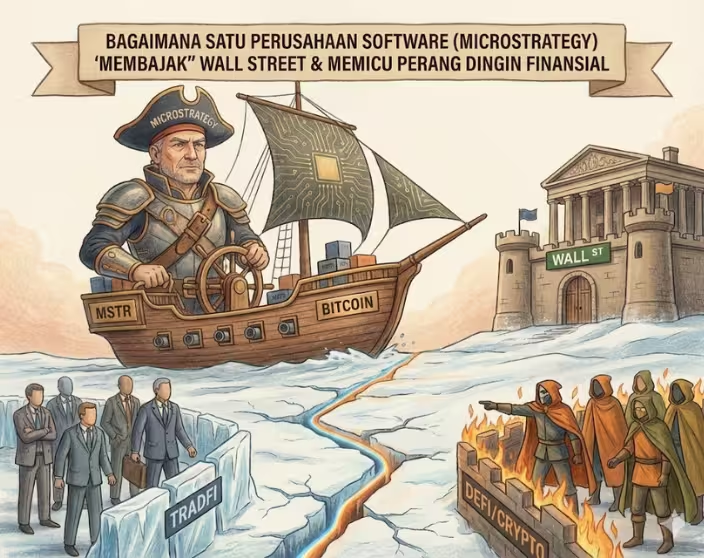
THE INDEX WARS: How Software Monopolies Hijacked Wall Street and Ignited a Financial Cold War

The Thermometer Fallacy: When Measurement Dictates Reality Before analyzing board room power dynamics or billionaire ego battles, we must deconstruct a foundational concept often dismissed as trivial yet serving as the root of current market distortions: The Stock Index. Retail investors typically view the S&P 500, Nasdaq, or IHSG merely as “scoreboards”; digital displays in a stadium indicating winners and losers. This assumption is a fatal error. The function of the index has quietly mutated. It is no longer a passive observer. It has evolved into the referee holding the whistle; historically, it has become the rule-maker itself. To understand how a single administrative decision can reallocate triliions in global capital, we must examine the genesis of this structure. The Legacy Problem: Fragmentation of Reality Consider the New York Stock Exchange in the early 1900s. The atmosphere was chaotic. In one corner, rail valuations surged; in another, steel manufacturers collapsed; meanwhile, cotton remained stagnant. Was the market up or down? In that era, the answer depended entirely on where one looked. The financial world was effectively blind. There was no standardized definition of “economic health.” Bankers and allocators required a simplifying mechanism: a thermometer to gauge the aggregate temperature of the system. The Basket Theory: A Statistical Shortcut The solution was the “Basket Theory.” Early economic architects realized monitoring thousands of equities daily was operationally impossible. They opted for a statistical shortcut: selecting a handful of industrial giants to represent the broader economy. The logic parallels CPI (Consumer Price Index) calculation. One does not price every item in a supermarket to measure inflation; one tracks a basket of staples: rice, oil, eggs, sugar. If these four appreciate, the cost of living is rising. This necessitated the birth of the Dow Jones Industrial Average. The philosophy was explicit: If these 30 industrial titans are profitable, the US economy is likely robust. At this historical juncture, the Index was strictly a Measurement Tool. Like a thermometer on a wall, it objectively reflected the ambient temperature (30°C). Crucially, a thermometer is passive; shattering it does not lower the room temperature. The index reflected reality; it did not create it. The Evolution: From Observation to Benchmarking Over time, the utility of the index shifted. The financial sector became obsessed with efficiency and relative performance. Asset owners—LPs and high-net-worth individuals—required a metric to audit the performance of their fiduciaries. How does one distinguish a skilled fund manager from an incompetent one? The market demanded a Benchmark. Here, the Index transitioned from “Thermometer” to “Answer Key.” The S&P 500 or MSCI World ceased to be mere data points; they became the standard for solvency and success. This shift triggered a massive psychological and operational consequence. Asset managers globally began working with a single obsessive mandate: minimize tracking error against the Index. The Index became the Sovereign. It became the mandate. The New Hegemony: The List Makers We now arrive at the core of the modern structural issue. When the global financial system agrees to utilize a singular standard, the critical question arises: Who determines the composition of the Index? Retail participants often assume Indices are managed by Government bodies, Central Banks, or neutral regulators. This is false. Entities like MSCI (Morgan Stanley Capital International) and S&P (Standard & Poor’s) are private corporations. They are profit-maximizing entities. Their primary product is not equity; it is Intellectual Property and Data Licensing. Effectively, they state: “We possess the most sophisticated methodology for basket construction. You must use our basket as the standard for your performance attribution.” The market capitulated. Here lies the supreme irony. Initially designed to track the market, the Index now dictates it. Because trillions in pension funds, insurance capital, and sovereign wealth are pegged to index performance, the causality has inverted. Public companies now aggressively restructure to meet MSCI inclusion criteria. Inclusion guarantees automatic, passive capital inflows. Exclusion equates to a slow death by liquidity strangulation. The Index is no longer a passive Thermometer; it has evolved into a Thermostat. If MSCI adjusts the dial, the market heats up. If they dial it back, liquidity freezes. We have surrendered control of the global economic “temperature” not to natural market discovery, but to the closed-door committees of a few private software monopolies. When this “Thermostat” decides to freeze a specific asset class, the resulting volatility can trigger unforeseen systemic shocks. However, to comprehend the magnitude of this storm, we must examine how human complacency drove investors to surrender their capital entirely to the “Robot”—the rise of Passive Investing. The Era of Alpha Decay Until the mid-1970s, capital allocation was a theater of ego. This was the reign of the “Stock Picker.” The archetype of the “Master of the Universe” dominated the era: high-touch, high-fee, and driven by the conviction that one could predict the future through sheer intellect. The operational model was manual and exorbitant. Allocators handed capital to Active Managers with a single mandate: Be smart. The manager analyzed balance sheets, toured factories, and leveraged proprietary networks to execute a binary decision: Buy Asset A, Sell Asset B. The objective was singular: Generating Alpha (Beating the Market). If the market returned 10%, the manager aimed for 15%. For this perceived genius, they charged a premium—often the classic “2 and 20” structure—regardless of performance. However, the mathematics eventually collapsed. Decades of statistical data revealed a painful reality: The majority of professional managers, despite Ivy League pedigrees and information asymmetry, failed to outperform the benchmark over the long term. High management fees eroded returns. What was sold as skill was frequently just random distribution luck. The Paradigm Shift: Owning the Haystack Amidst the collective failure of “Smart Money,” John Bogle, the founder of Vanguard, introduced a concept so radical it was initially branded “Un-American.” Bogle’s thesis was elegant in its simplicity: Active stock selection is akin to searching for a needle in a haystack. The cost of the search exceeds the value of the needle. His solution: Stop searching. Buy the haystack. This marked the genesis of … Read more

Monero vs. Zcash: Absolute Privacy vs. Regulatory Compliance

Monero vs. Zcash: Privasi Absolut VS Privasi patuh Regulasi

A fascinating anomaly is currently unfolding in the crypto market. Even as regulatory scrutiny tightens globally, a select group of privacy coins is recording significant value appreciation. This phenomenon presents a clear paradox. On one hand, the world is moving toward total surveillance where financial anonymity seems impossible. On the other hand, the market demand for genuine privacy is becoming louder than ever. In practice, the illusion of anonymity on standard blockchains is easily shattered. Rapid advancements in blockchain analytics tools, such as those developed by Arkham or Chainalysis, allow specific parties to track and cluster transaction patterns. The biggest vulnerability lies with Centralized Exchanges (CEX). Mandatory Know Your Customer (KYC) procedures effectively link real-world identities to specific wallet addresses. Once that connection is made, an individual’s entire transaction history, balance, and investment activity become an open ledger. This is the core of the issue. Many crypto users argue that while transparency at the system level is necessary, absolute transparency at the individual level is highly undesirable. For most investors, the idea that anyone can view their balances and history is deeply uncomfortable. It is essentially the same as posting our bank account details and asset portfolios for the public to see. The implications go beyond comfort; they involve real personal security. Public knowledge of someone’s wealth can endanger that individual and their family. The need for privacy is even more critical at the institutional scale. A financial institution or major corporation cannot operate on a fully transparent blockchain. Their entire list of counterparties, transaction volumes, and strategic asset accumulations would be easily identified by competitors. This not only destroys competitiveness but also makes it impossible for them to meet existing regulatory requirements, particularly those regarding customer data confidentiality. This is one of the main reasons why many banks and large financial institutions remain hesitant to fully enter the crypto ecosystem. They have not yet found assurance that customer privacy can be adequately protected. Monero (XMR): The Gold Standard of Absolute Privacy When discussing privacy coins, all roads lead to one name: Monero (XMR). Launched in 2014, Monero is not just a legacy player. It has become the primary benchmark used to measure the success of all other privacy projects. Its decade-long existence proves its resilience. Throughout its journey, Monero has been the prime target for anyone attempting to break blockchain anonymity. From analytics firms armed with sophisticated tools to various government agencies, many have tried to penetrate its defenses. Remarkably, Monero has successfully maintained user privacy to this day. Monero operates on a Proof-of-Work (PoW) consensus mechanism, meaning it is mined just like Bitcoin. However, there is a fundamental difference. Monero utilizes an algorithm specifically designed to be ASIC-resistant. ASICs are expensive hardware chips built for a singular purpose, such as calculating SHA-256 hashes for Bitcoin. Standard chips can never compete with them. In contrast, the Monero algorithm is intentionally complex and constantly changing to make ASIC processing inefficient. This design allows anyone with a standard CPU to participate in mining. The result is a level of network decentralization that theoretically exceeds Bitcoin, where mining is now dominated by heavily capitalized entities. Monero’s privacy edge does not rely on a single trick. Instead, it utilizes three layers of technology that work in unison and remain “always on” for every transaction: Regarding performance, Monero features a unique dynamic block size design. Blocks can expand dynamically as needed when network traffic spikes. Because of this capability, Monero claims the ability to handle high volumes, theoretically reaching up to 2,000 transactions per second (TPS). At a glance, this rivals Visa’s transaction processing throughput. However, there is a trade-off. Transaction finality ranges between 20 to 40 minutes. Monero developers state this is the necessary cost for the multi-layered cryptographic security they deploy. The economic model is also distinct. After the first 18 million XMR were mined in its first six years, Monero shifted to a “tail emission” phase in 2022. In this phase, 0.6 new XMR is created in every mined block forever. This means Monero does not have a fixed maximum supply. The objective is to ensure miners remain incentivized to secure the network indefinitely while maintaining a stable and permanently low inflation rate. Zcash (ZEC) and the Philosophy of Optional Privacy While Monero represents non-negotiable absolute privacy, Zcash (ZEC) introduces a fundamentally different approach. Launched in 2016, Zcash is effectively a fork of Bitcoin. Its primary objective was to engineer a more private version of Bitcoin while retaining core characteristics like the 21 million maximum supply cap. Zcash also utilizes a Proof-of-Work (PoW) mechanism via the Equihash algorithm. Initially, Zcash was designed to be mined with standard computers which mirrored Monero’s decentralization philosophy. However, this commitment shifted in May 2018 when Bitmain released specific ASIC miners for Zcash. Since that pivot, mining Zcash requires expensive specialized hardware. This decision effectively alienated home miners and has arguably reduced its degree of decentralization. The most fundamental divergence between Zcash and Monero lies in their operational philosophies. Privacy on Monero is always active and mandatory. Privacy on Zcash is optional. Users can select their desired level of privacy for each specific transaction. This flexibility is made possible through two distinct address types: The combination of these addresses creates a spectrum of flexibility. If a transaction occurs between two T-Addresses, it is 100% public. If a sender uses a Z-Address to pay a T-Address, the public sees only the recipient and amount. Conversely, if a T-Address sends to a Z-Address, the public knows only the sender. Full privacy occurs only when both the sender and receiver utilize Z-Addresses. In this scenario, the transaction is completely private. Technologically, the Zcash privacy implementation is highly sophisticated and has not been successfully breached by blockchain analytics firms or governments. Yet, ironically, the vast majority of transactions on the Zcash network remain public. This strategic weakness is not a technological failure but the result of external factors. Most Centralized Exchanges (CEX) bound by KYC regulations do not support … Read more