
The Great Decoupling: Why Bitcoin No Longer Fears The Fed
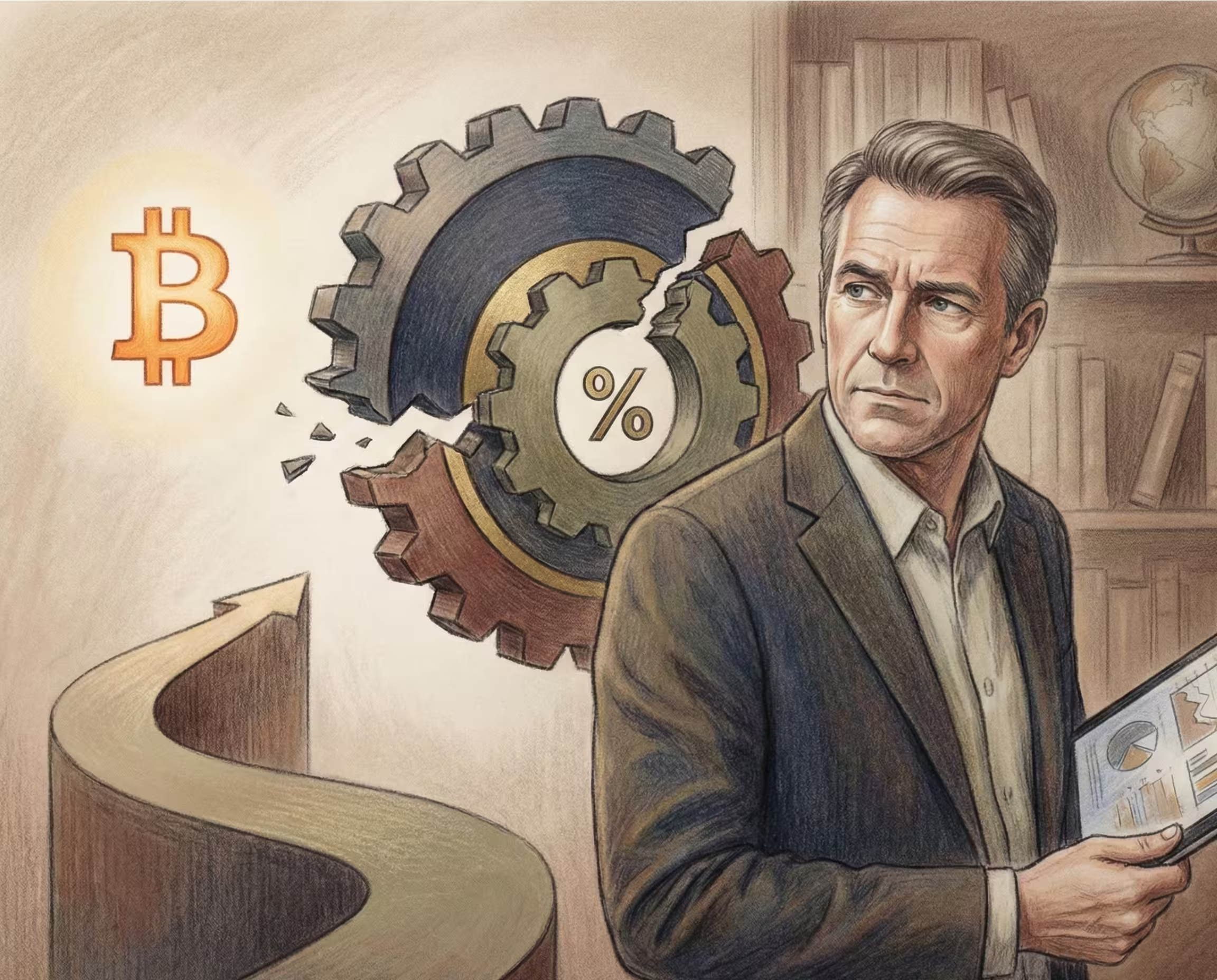
THE ILLUSION OF CORRELATION EXECUTIVE SUMMARY CHAPTER 1: The Pavlovian Trap (Behavioral Arbitrage) The digital asset market is currently suffering from a severe case of collective delusion. As of February 2026; Bitcoin has corrected to the $70,000 range; a drawdown exceeding 20% from local highs. The consensus reaction across the spectrum; from X (formerly Twitter) threads to paid signal groups; is uniform: “We need the Fed to cut rates to restore momentum.” This represents a fatal form of analytical complacency. Retail investors are exhibiting behavior akin to the subjects in Ivan Pavlov’s experiments: they hear the bell (Rate Cut news) and immediately salivate (Buy). They fail to recognize a critical shift in market structure: in 2026; the bell likely does not signify dinner. It signifies the opening of the abattoir. The Retail Delusion: Binary Thinking The primary vulnerability of the retail cohort is Binary Thinking. This logic held validity during the 2009-2021 epoch due to low inflation and manageable sovereign debt levels. However; applying a 2020 framework to the 2026 market environment is tantamount to capital destruction. The macro context has shifted from Monetary Dominance (Fed control) to Fiscal Dominance (Sovereign Debt/Deficit control). If the Federal Reserve cuts rates today; it is likely not a sign of victory over inflation. It indicates that a component of the banking system or the Treasury market has fractured. In a Hard Landing or Recession scenario; risk assets like Bitcoin do not rally. They are liquidated to cover margin calls in traditional equity and credit markets. Anticipating a rate cut without analyzing the catalyst for said cut is indistinguishable from blind gambling. Institutional View: Algorithmic Predation While retail participants refresh economic calendars awaiting CPI prints; Institutional Capital and High-Frequency Trading (HFT) firms are engineering traps. Institutions are indifferent to a 0.1% variance in CPI. Their primary focus is the location of your Liquidity (Stop Losses). The Institutional “Stop Hunt” Mechanism: At Corequil; we define this phenomenon as a “News-Based Liquidity Grab.” If your strategy relies solely on the economic calendar; you are not an investor; you are yield for the algorithms. The False Narrative: Historical Reality Check Let us examine the data. The narrative that “Fed Pivots always trigger Bull Runs” is a fallacy repeated until it mimics truth. Financial history reveals a more brutal reality. The following matrix compares market reactions to Rate Cuts across differing economic regimes: Era Rate Cut Catalyst Economic Condition Risk Asset Reaction (S&P 500 / BTC) Status 2000 (Dot Com) Equity Market Collapse Recession CRASH (-50%) post-Pivot Bear Trap 2007-2008 (GFC) Banking Crisis Systemic Recession CRASH (-57%) post-Pivot Bear Trap 2019 Global Slowdown Stable Rally (Pre-COVID) Normal 2020 (COVID) Pandemic External Shock V-Shape Recovery (Due to Massive QE) Outlier 2026 (Current) ??? Stagflation / Debt ??? High Risk Table Analysis:Observe the correlation in 2000 and 2008. The Fed cut rates aggressively; yet the market capitulated. The cause: those Rate Cuts were panic responses to a dying economy. In 2026; with Bitcoin correcting at $70k and prediction markets pricing in cuts; the critical inquiry is this: Is the Fed cutting because inflation is tamed (Bullish); or because the US Bond Market is facing a liquidity crisis (Bearish)? If the answer is the latter; the positive correlation between Bitcoin and Rate Cuts will decouple. We are entering uncharted territory where holding Cash carries risk parity with holding assets; yet relying on a Fed bailout is a hollow strategy. The 2020 playbook is obsolete. Burn it. CHAPTER 2: The “Broken” Money System (Diagnosis: Jeff Park) With the illusions of the previous cycle incinerated; we must now confront the structural decay of the engine itself: The Federal Reserve’s control console has been severed from the drivetrain. For the past forty years; Jerome Powell and his predecessors operated with a single; binary lever: Interest Rates. In 2026; this lever is no longer connected to the economic reality. The Monetary Transmission Mechanism has suffered a catastrophic failure. Jeff Park; Head of Alpha Strategies at Bitwise (formerly ProCap); is one of the few institutional voices articulating the unsaid reality: We are approaching the event horizon of “Positive Rho.” First Principles: The Dead Steering Wheel Why has the mechanism failed? The answer lies in the arithmetic of the US Sovereign Debt stack; which has now breached $38 Trillion. In a low-debt regime (circa 1980-2000); raising rates effectively drained liquidity. Borrowing costs surged; corporate expansion halted; consumption slowed; and inflation cooled. However; under the current regime of Fiscal Dominance; raising rates triggers a lethal paradox.The US Government is the world’s largest borrower. When the Fed hikes rates to 5%+; the Treasury is mathematically obligated to pay significantly higher interest expenses to bondholders. As of February 2026; the US pays over $1.5 Trillion annually solely in interest. This is not credit creation; this is fresh capital injection (deficit spending) flowing directly into the balance sheets of institutions and high-net-worth entities. The Consequence: The Fed attempts to brake the economy via hikes; yet the Treasury inadvertently sprays trillions in fiscal stimulus to asset holders. It is the monetary equivalent of attempting to extinguish a fire with gasoline. The “Positive Rho” Theory (Jeff Park’s Thesis) This paradox forms the core of Jeff Park’s thesis; potentially the “Holy Grail” or Endgame for Bitcoin. In derivatives finance; Rho ($\rho$) measures an option’s sensitivity to interest rate changes. Traditional risk assets typically exhibit “Negative Rho” (Rates Up -> Asset Prices Down). Park argues that Bitcoin is evolving into a Positive Rho Asset.In this paradigm; Bitcoin’s price appreciates in tandem with rising interest rates. The Mechanism: If you observe Bitcoin surging while Powell delivers a Hawkish press conference; do not view it as an anomaly. It is the market repricing Bitcoin as insurance against systemic fiat failure rather than a speculative tech proxy. Skeptic View: The Deflationary Abyss Intellectual honesty demands we stress-test this thesis. Will the transition to “Positive Rho” be linear? No. The primary risk is Timing.Before the fiscal money printer completely overrides the monetary brakes; we face the risk of … Read more

The New Monetary Trilemma: The Dollar, The Yuan, and the Rise of Sovereign Assets

EXECUTIVE SUMMARY: ALPHA CHAPTER 1: The Xi Doctrine & The Qiushi Manifesto Ignore the daily noise regarding Shanghai stock fluctuations. To understand the trajectory of global capital over the next decade, one must dissect Xi Jinping’s early 2024 publication in the Qiushi journal. This is not an op-ed; it is an Imperial Decree. Xi declared the vision of Jinrong Qiangguo (Financial Strong Nation). This signals a brutal realization in Beijing: being the “World’s Factory” is insufficient. Without control over global payment rails, China’s physical wealth remains a hostage to an increasingly weaponized US Dollar system. Sovereignty Over GDP For two decades, “Yuan Internationalization” was merely a marketing slogan. The Qiushi doctrine converts it into a military mandate. The catalyst? The 2022 freezing of Russian central bank assets. For the CCP, Reserve Currency status is no longer about trade efficiency; it is a Sovereignty Shield. Xi established three pillars in this manifesto: Implication: Institutional capital must anticipate a structural reduction in Chinese purchases of US Treasuries. Expect a reallocation of trade surpluses into propping up the Yuan and acquiring strategic hard assets (Gold/Commodities). Defying the Laws of Economic Gravity Here, academic skepticism is warranted. Xi’s ambition collides head-on with the Impossible Trinity (Mundell-Fleming Model). Macroeconomic theory dictates a nation cannot simultaneously possess: China maintains strict exchange control and independent policy, yet restricts capital flow (Closed Capital Account). The Problem: To become a true Global Reserve Currency (like the USD), liquidity must be bidirectional. Global allocators will not store wealth in Yuan if they fear capital controls during a crisis. Xi is attempting to engineer a “Hybrid System”: a market open to institutions (via Swap Lines and CIPS) but closed to retail speculators. History suggests this will fail; Xi is betting that political will can bend economic law. Loyalty Over Alpha The most bearish signal for foreign investors is the cultural purge within China’s financial sector. Xi has explicitly demanded the eradication of “hedonistic” lifestyles among bankers, calling for “Marxist Financial Cadres.” This is not rhetoric. The Central Commission for Discipline Inspection has detained dozens of high-level executives since 2023. The message is binary: The bank’s function is to serve the Party’s strategic goals, not to maximize ROE. This creates a new systemic risk: Extreme Risk Aversion. Chinese bankers now fear political missteps more than missed revenue. Consequently, credit allocation will likely shift away from productive sectors (private tech/startups) toward “politically safe” sectors (SOEs and infrastructure), exacerbating capital inefficiency. CHAPTER 2: The PBOC Arsenal & The Valuation Gap If Chapter 1 defined the “Political Intent,” Chapter 2 defines the “War Chest.” Western media often misinterprets Yuan weakness as a sign of economic collapse. This is lazy analysis. The reality on the Shanghai exchange is far more calculated. The PBOC is not panicking; they are playing 4D chess against global speculators. The 25% Gap: A Valuation Time Bomb Consider the numbers that keep Wall Street macro strategists awake. Goldman Sachs valuation models indicate the Renminbi is undervalued by approximately 25% against its fundamental fair value. The Implications: For USD-denominated asset holders, this represents a massive devaluation of purchasing power. For holders of Yuan-denominated assets (or negative-correlation assets like Gold/BTC), this is the repricing event of the century. Anatomy of Intervention: Behind the 7.0 Curtain How does China control this volatility? Unlike the Fed’s transparent Open Market Operations, the PBOC utilizes a “Dark Arsenal.” The 7.0 USD/CNY level is a sacred psychological line. When the market challenges this level, the PBOC activates two specific mechanisms: 1. The Counter-Cyclical FactorAt 9:15 AM Beijing time, the PBOC sets the daily fixing. The formula contains variable “X”: the Counter-Cyclical Factor. This is effectively a “Mathematical Veto,” allowing the PBOC to ignore prior market movements and set the price according to Party objectives. 2. The National Team (Shadow Intervention)The PBOC rarely intervenes directly. Instead, they order the “Big Four” State Banks to execute massive Dollar sells in offshore markets (Hong Kong/London). This drains Dollar liquidity, spikes the cost of shorting the Yuan, and liquidates speculators betting against Beijing. This is not a free market. It is a hostage market. The Export of Inflation If the PBOC allows the Yuan to permanently breach 7.0: User Alpha: For firms hedging imports from China, volatility around 7.0 is the danger zone. Hedging is no longer optional; it is a fiduciary duty. CHAPTER 3: Infrastructure of Hegemony (CIPS vs. SWIFT) If policy is the software, CIPS (Cross-Border Interbank Payment System) is the hardware. Without independent rails, Xi’s ambitions are theoretical. For 50 years, global banking accepted one reality: SWIFT is absolute. Post-2022 G7 sanctions on Russia, that perception shattered. SWIFT is no longer a neutral utility; it is a geopolitical weapon. CIPS is China’s construction of a financial anti-nuclear bunker. The Plumbing Difference Public discourse confuses SWIFT and CIPS. Let’s clarify via functional analogy: Architectural Advantage:China designed CIPS to process cross-border RMB payments directly, bypassing NY correspondent banks. In the legacy system, an Indonesia-China trade settled in USD must “touch” a US bank server for clearing. In that split second, the US Treasury can freeze the funds. With CIPS, a Jakarta-Shanghai transaction settles point-to-point on the PBOC ledger. Instant finality; zero US oversight. The Global South Liquidity Migration Volume data confirms the trend. CIPS transaction value is hitting annual records, driven by the collective anxiety of the BRICS+ bloc. Why are the Saudi Central Bank and Brazil aggressively accumulating CGBs (China Government Bonds)? This is the birth of a Parallel Capital Circuit. Preparing for the “Taiwan Scenario” Beijing is not building CIPS for profit; they are building it for survival. Strategic planners in Zhongnanhai are stress-testing the worst-case scenario: a Taiwan conflict. If that day arrives, the US/EU will almost certainly sever China’s access to SWIFT. Without a mature CIPS, China—the world’s largest exporter—would suffer instant cardiac arrest. Weaponization of Finance:China’s strategy is to force key trading partners (Russia, Iran, ASEAN, Africa) to adopt CIPS now, during peacetime. The goal is to ensure that when the sanctions button is pressed, the … Read more