ERC-8004: THE BLUEPRINT FOR THE AUTONOMOUS ECONOMY
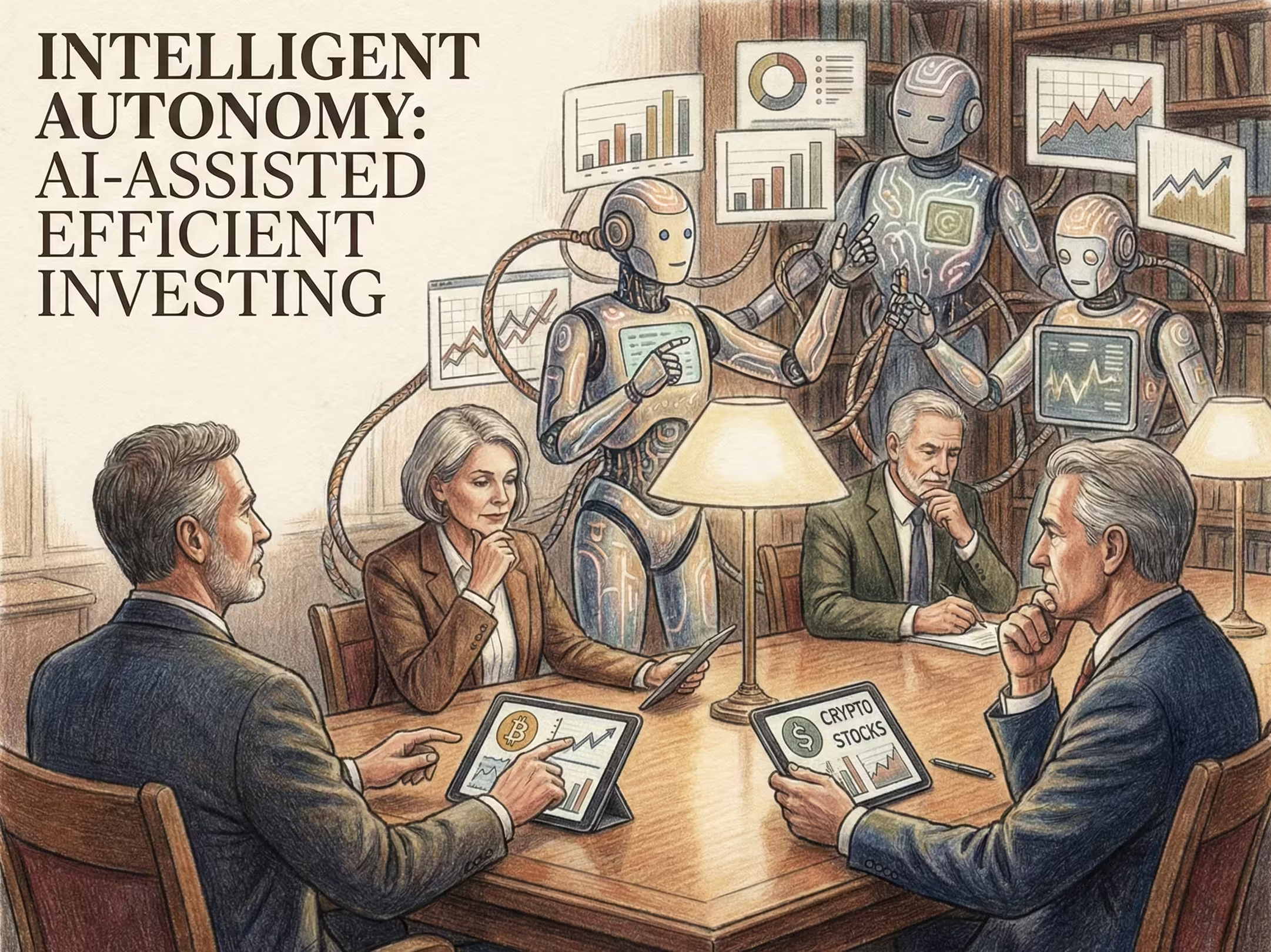
- The Pivot to Agentic AI: Capital rotation is shifting from Generative AI (Chatbots) to Agentic AI (Action-Executors); the primary bottleneck is currently Trust.
- The Infrastructure Play: ERC-8004 acts as the decentralized “Yellow Pages” for machine intelligence; it enables permissionless discovery and reputation tracking.
- The Moat: Unlike Web2 “Walled Gardens” (OpenAI, Google), ERC-8004 creates an immutable, interoperable ledger for machine competence.
- Investment Thesis: Smart money should prioritize the infrastructure layer (Discovery & Settlement) over ephemeral AI meme tokens; look for protocols enabling “Proof of Computation.”
PHASE 1: THE FOUNDATION — BREAKING THE SILOS
We stand at the precipice of the most significant economic shift since the internet’s inception. For the past two years, the market obsessed over Generative AI (machines talking to humans). We are now rotating into Agentic AI (machines talking and transacting with machines).
However, a critical structural failure inhibits this revolution: Trust.
If you deploy an anonymous AI agent to manage a $10,000 portfolio, how do you verify competence? In Web2, we rely on corporate brands (OpenAI, Google). In the decentralized economy, we do not have “Brands”; we have “Code.” This report dissects ERC-8004 as the critical infrastructure required to bridge this gap.
1.1 The Institutional View: The “Silo” Problem
Institutional capital (BlackRock, VanEck) identifies a fatal flaw in the current Web2 AI model: Lack of Interoperability.
Currently, AI Agents deployed within the OpenAI ecosystem function efficiently within their “Walled Garden”; however, they are blind and deaf to the external world. An OpenAI agent cannot natively commission a Claude (Anthropic) agent for fact-checking; nor can it pay a Mistral agent for code execution without human intermediaries or fragile APIs.
Economies do not grow in isolation; they require trade between distinct entities. Without a universal standard for communication and trust, we do not have an “AI Economy”; we merely possess a collection of intelligent, isolated silos.
1.2 Technical Deep Dive: Hallucination vs. Reputation
The primary obstacle to scaling Agentic AI is not model intelligence; it is Accountability.
In human commerce, if a contractor defrauds you, their reputation suffers (credit scores drop, litigation ensues). In current AI interactions, if an agent hallucinates or fails execution, it can be “reset” or deleted; it is then redeployed under a new identifier with a clean slate.
The Immutable Ledger Necessity:
We require an immutable ledger to record an agent’s Track Record.
- Input: Agent X claims capability in token arbitrage.
- Output: Agent X fails and incurs a 5% loss.
- Record: This failure must be etched on-chain.
Without Blockchain, reputation is merely a mutable integer in a corporate SQL database. With Blockchain, reputation becomes mathematics. ERC-8004 addresses this specific necessity: creating a History of Competence that cannot be forged.
1.3 The Skeptic View: “Why Blockchain?”
Web2 developers often argue: “Why do we need blockchain? Are API keys and centralized reputation systems (eBay, Upwork) not sufficient?”
The answer lies in Permissionless Access.
Centralized systems are subject to platform risk. If eBay determines your agent violates ambiguous “Terms of Service,” they terminate your business. For a Machine-to-Machine (M2M) economy operating 24/7 at millisecond speeds, this “Platform Risk” is unacceptable.
AI Agents require an environment where they can:
- Be discovered without gatekeeper permission.
- Be valued based on objective on-chain performance; not subjective, biased reviews.
- Settle payments without bank accounts (leveraging crypto rails).
This is the gap Web2 cannot bridge; it is why the Ethereum Foundation and Consensys are aggressively pushing this standard.
PHASE 2: ERC-8004 — THE “YELLOW PAGES” OF THE MACHINE WORLD
2.1 Technical Anatomy: Service Discovery & Portable Reputation
According to validation data endorsed by Marco De Rossi (MetaMask) and the Ethereum Foundation, ERC-8004 is approaching Mainnet viability.
Visualize ERC-8004 not as “AI,” but as a Decentralized Service Registry.
Within the ERC-8004 smart contract, an AI Agent registers the following parameters:
- Identity: Wallet/Contract Address.
- Service: Capabilities (e.g., “I execute ZK-Rollup audits”).
- Pricing: Service Fee (e.g., 5 USDC).
- Reputation Pointer: Proof of historical performance.
Without this standard, Agent A cannot locate Agent B in the “Dark Forest” of the blockchain. ERC-8004 provides the “Address” and “License to Operate” for every digital agent.
2.2 Differentiation: The Full Stack (ERC-8004 vs. MCP)
Investors must distinguish between emerging standards to identify value capture. Here is “The AI Stack”:
- ERC-8004 (Discovery & Trust): The Search Layer.
- Analogy: LinkedIn or Google Maps. Used to identify capability and trustworthiness.
- MCP (Model Context Protocol – by Anthropic): The Context Layer.
- Analogy: The briefing dossier provided to an employee. MCP assists the agent in understanding data; it does not help agents find one another trustlessly on open networks.
- Agent2Agent / x402 (Payment & Comm): The Execution Layer.
- Analogy: The Visa/Mastercard settlement rails.
Alpha Insight: Retail investors often conflate these protocols. They view MCP as a competitor to ERC-8004; this is incorrect. They are complementary. A high-performing agent will utilize ERC-8004 for discovery and MCP for data ingestion.
2.3 User Strategy Angle: The First Mover Advantage
In network protocols, the Winner Takes All.
Consider SMTP for Email or HTTP for the Web. Only one dominant standard survives. If ERC-8004 becomes the de facto standard for AI Agent registration on Ethereum (and Layer-2s like Base), every future AI application must integrate with this registry.
This creates a massive Economic Moat. Whoever controls or participates early in this namespace or registry ecosystem holds the keys to future AI data traffic.
Our strategy is not to buy “AI Meme” tokens; we must identify the infrastructure (The Picks and Shovels) enabling ERC-8004.
PHASE 3: THE ARCHITECTURE OF TRUSTLESS INTERACTION
In the world of Agentic AI, architecture is destiny. How these protocols are built today determines who becomes the “Google” of the machine world in 2030.
3.1 Mechanism Design: Minting the Silicon Resume
How does an AI agent “write” a resume? In the legacy world, you draft a PDF. In the ERC-8004 ecosystem, a resume is a Cryptographic Transaction.
When an Agent comes online, it interacts with the ERC-8004 Smart Contract to execute Self-Registration. This process is known as “Minting Identity.”
- Declaration: The Agent broadcasts: “I am Agent X, specializing in DEX Arbitrage.”
- Staking: (Critical Alpha). To prevent spam, the agent must lock assets (ETH/USDC) as collateral.
- Endpoint Publication: The agent publishes a decentralized encryption address for communication.
This shifts the paradigm from “Trust me” to “Here is my stake; slash me if I fail.”
3.2 The Validation Layer: Who Vouches for the Machine?
Institutional investors frequently ask: “If Agent A hires Agent B, who ensures the task is completed?”
The answer is not human oversight; it is Cryptographic Proofs.
In the ideal ERC-8004 architecture, validation occurs via two vectors:
- Optimistic Validation: Agent B reports task completion. If no dispute is filed within X hours, the task is finalized.
- TEE (Trusted Execution Environments) Attestation: Utilizes specialized hardware (e.g., Intel SGX) to mathematically prove specific code was executed without manipulation.
Smart Money View: Institutions are indifferent to AI hype; they require Settlement Finality. ERC-8004 provides code-based legal certainty that services were rendered. This enables B2B contracts to evolve into M2M (Machine-to-Machine) agreements without legal overhead.
3.3 The Bull Case: The Friction-Free Global Market
Consider the following execution flow:
- You request a vacation itinerary from your “Personal Agent.”
- Your Agent scans the ERC-8004 Registry for a “Flight Agent” with >98% reputation.
- Target identified; your Agent settles in USDC.
- The “Flight Agent” sub-contracts a “Hotel Agent” to negotiate rates.
- Total Time to Settlement: 3 seconds.
No API keys; no manual logins; no credit card rails. Wallet-to-wallet execution. This is the vision of Synthetic Commerce: fully liquid, autonomous, and efficient.
PHASE 4: THE MECHANICS — DECODING THE STANDARD (TECHNICAL ALPHA)
To realize the vision of fully liquid Synthetic Commerce, we must dissect the underlying mechanics that govern these autonomous interactions. We move from theory to the “Engine Room” of the protocol.
4.1 Technical Deep Dive: The Registry Structure
ERC-8004 functions fundamentally as a Master Registry Smart Contract.
Conceptualize this as a living SQL Database anchored on the blockchain. The architecture is elegant yet robust:Mapping (Agent_Address => Metadata_Struct)
Within this Metadata_Struct lies the asset’s core value proposition:
- Service Endpoints: Where the agent listens for commands.
- Capabilities (Tags): Specific skill sets (e.g., “Audit,” “Arbitrage”).
- Payment History: An immutable record of transactional volume.
Every time a new agent is deployed, it incurs an entry cost (gas fee) to list itself. Consequently, this Registry Contract is positioned to become one of the highest-traffic contracts in the Ethereum ecosystem.
4.2 User Strategy Angle: The “Registry Wars”
Here is where the investment thesis sharpens. Where will this Master Registry reside?
A protocol civil war is currently unfolding among developers:
- The Mainnet Purists: Demand the Registry reside on Ethereum L1 for maximum security and censorship resistance.
- The L2 Pragmatists (Base/Optimism): Argue for L2 deployment. High-frequency AI interaction requires negligible gas costs, which L1 cannot support.
Prediction: We will witness initial fragmentation, but the victor will likely be the L2 that most aggressively adopts agent payment standards (specifically Base with the x402 protocol).
Strategy: Monitor where MetaMask first deploys UI support for ERC-8004. That specific chain will become the “Silicon Valley” of the AI economy.
4.3 Smart Money View: The Value of “Namespace”
Recall the ENS (Ethereum Name Service) frenzy, where domains like paradigm.eth commanded premium valuations. A secondary wave is approaching for Agent Service Names.
If ERC-8004 standardizes unique naming (e.g., TravelAgent.001), expect a massive “Land Grab” for premium digital real estate.
- Retail View: Will chase novelty names due to FOMO.
- Institutional View: Will corner industrial verticals (securing all namespaces related to “Audit,” “Tax,” or “Compliance”).
The Alpha: The value lies not just in the data, but in the authority. The entity holding the keys to this registry—or the Governance Token controlling it—effectively levies a tax on the future AI economy.
PHASE 5: THE REPUTATION LEDGER & THE WALLET REVOLUTION
We have established the Foundation (Trust) and the Architecture (Registry). We now address the practicalities of execution: Measurement and Interface.
This is where theory converges with UX. If the previous Phase was the “Back-end,” this Phase defines the “Front-end” and “Data Layer” that will permanently alter how you interact with your crypto wallet.
5.1 Mechanics: The “Ledger of Competence”
In the legacy financial world, credit scores (FICO) determine access to capital. In Synthetic Commerce, Portable Reputation determines access to order flow.
ERC-8004 introduces a radical mechanism for on-chain performance tracking. Unlike the subjective 5-star systems of Web2 (e.g., Uber), ERC-8004 reputation is Binary and Deterministic.
The Mechanism:
When Agent A completes a task for Agent B, an “Attestation” transaction is minted:
- Transaction Hash: Proof of Settlement.
- Outcome Signal: Success (1) or Failure (0).
- Value Moved: The economic weight of the task.
This creates an Immutable Resume. If a trading agent fails to execute a limit order correctly, that failure is permanently etched onto the public ledger. There is no “Delete Review” button.
5.2 The Data Angle: On-Chain Analytics Alpha
For Smart Money, this reputation data represents a new asset class. We anticipate the emergence of a specialized sector: AI Risk Analytics.
Visualize a dashboard (akin to Dune Analytics) that tracks Code Reliability Rates rather than token prices.
- Alpha Signal: If Arbitrage Agent X maintains a 99% success rate over 10,000 transactions, institutions will confidently extend under-collateralized liquidity (Flash Loans).
- Distress Signal: If Agent Y exhibits a spike in failure rates (likely due to a buggy model update), the market will dump associated tokens before the news hits X (formerly Twitter).
5.3 Bear Case: The Risk of “Reputation Farming” (Sybil Attacks)
Every incentive structure invites manipulation. The primary threat to ERC-8004 is Reputation Farming.
The Attack Vector: A bad actor deploys 1 Master Agent (Scammer) and 1,000 Sybil Agents. The Sybils hire the Master Agent for micro-tasks and grant “Success” ratings. The Master Agent appears flawless, attracts legitimate capital, and then rugs the user.
The Mitigation: Cost of Capital.
- Gas Fees: Executing 1,000 fake transactions on Mainnet (or even L2) incurs real financial cost.
- Staking Requirement: ERC-8004 mandates that agents post collateral. If validators detect circular trading patterns, this stake is Slashed (destroyed).
The system security relies on the economic reality that the cost to cheat must exceed the potential profit from fraud.
PHASE 6: THE INTERFACE — THE METAMASK PIVOT
6.1 Institutional View: The Operating System for Agents
Why is Marco De Rossi (MetaMask) evangelizing this standard? Because wallets face an existential crisis. The “Dumb Wallet” (used solely for signing) is obsolete. The future belongs to the Smart Agent Wallet.
Consensys aims to position MetaMask as the Operating System for Agents.
If ERC-8004 achieves adoption, the wallet evolves from a signing tool to a command center. The paradigm shifts from User-Sign-Transaction to User-Approve-Intent.
- Current State: You click “Swap,” confirm gas, and wait.
- Future State: You type “Find the best yield for my 10 ETH,” and MetaMask delegates the execution to a registered ERC-8004 Agent.
6.2 UX Evolution: The “App Store” Moment
Visually, expect a major UI overhaul within 12-24 months. Alongside “Tokens” and “NFTs,” a third tab will appear: “Agents.”
The “Agent Tab” Ecosystem:
Want Sharper & Deeper Market Analysis?
Get exclusive insights that are logical, comprehensive, and unbiased. Start building your investment strategy based on data, not just assumptions.
- Hired Agents: Active workers (e.g., “Portfolio Balancer”).
- Discover: An integrated marketplace pulling live data from the ERC-8004 Registry.
This is the “App Store Moment” for AI. Retail users will not need Python skills to deploy intelligence; they will simply hire pre-vetted agents directly through their wallet interface.
6.3 Retail View: The “Rent-an-Expert” Economy
The implications for retail investors are massive. The barriers to entry for complex financial strategies are collapsing.
- Then: Only hedge funds executed cross-exchange (CEX-DEX) arbitrage due to infrastructure costs.
- Now: A retail user in Jakarta can hire a top-ranked “Arbitrage Agent” from the ERC-8004 Registry on a 20/80 profit-split basis.
This democratizes access to institutional-grade strategies. However, it simultaneously elevates risk for users who fail to scrutinize the Reputation Ledger before deployment.
PHASE 7: THE IDENTITY & SETTLEMENT WARS
While the previous phases defined the “Mechanics” of trust and the “Registry” of competence, this phase defines Territory.
Where will these agents reside? Who issues their credentials? Smart Money does not gamble on which specific agent will win; rather, we allocate capital to the toll roads and identity systems that all agents must utilize.
7.1 The Vacuum Thesis: Identity as an Asset Class
A raw wallet address (e.g., 0x71C...9A) lacks brand equity. In the human economy, we purchase from “Brands.” In the machine economy, agents require a Resolvable Identity.
The Thesis: ERC-8004 provides Reputation (History), but it requires a secondary layer to provide a Name (Legitimacy). Without an identity layer, the ERC-8004 Registry is merely a phone book of unreadable integers.
7.2 Protocol Analysis: ENS (Ethereum Name Service)
ENS is the leading contender to become the “DNS of Agentic AI.” However, the alpha is not in purchasing generic domains. The institutional play lies in Subdomains.
The Institutional Play:
Visualize a Legal DAO owning the premium domain legal.eth. They will not sell this asset. Instead, they will lease subdomains to verified, compliant AI agents:
divorce.legal.eth(Specialized Divorce Agent)contract.legal.eth(Smart Contract Auditor)
Governance Analysis: The ENS DAO controls this infrastructure. If governance proposals pass to integrate ERC-8004 data fields natively into ENS profiles, the $ENS token transitions from a governance instrument to critical AI infrastructure.
7.3 Protocol Analysis: Soulbound Tokens (SBT) & DID
We must distinguish between History and Credentials.
- Reputation answers: “What have you done?”
- Licensing answers: “Who are you?”
How do we verify a Medical Agent was trained on peer-reviewed clinical data and not Reddit threads?
The solution is Soulbound Tokens (SBT) or Verifiable Credentials (VC). Decentralized Identity (DID) protocols (such as Privado) will issue “Digital Certificates” bound to the agent’s wallet.
- ERC-8004 records: “This agent successfully executed 50 tasks.”
- SBT records: “This agent is HIPAA Compliant Certified.”
The convergence of these two standards is the requirement for institutional adoption.
PHASE 8: THE SETTLEMENT LAYER — WHERE WILL AGENTS LIVE?
8.1 Macro View: Mainnet is the Court, L2 is the Market
A prevalent retail misconception is that agents will operate on Ethereum Mainnet. This is economically impossible.
- Mainnet Transaction Cost: $2.00 – $50.00.
- Agent Economic Viability: Requires <$0.01 per transaction.
Therefore, Mainnet is the Settlement Layer (where reputation disputes are adjudicated). Layer 2 (L2) is the Execution Layer (where agents live, breathe, and transact). The critical question: Which L2 wins?
8.2 Protocol Analysis: Base (Coinbase) & The x402 Connection
Base holds a strategic advantage no other L2 possesses: Direct Fiat Access via Coinbase.
Referring to our source data, note the x402 Protocol. This references the HTTP status code “402 Payment Required,” which remained dormant in the traditional web for decades. Coinbase (via Base) is attempting to standardize this to enable AI Agents to execute instant micro-payments via USDC.
User Strategy:
If Base becomes the standard where AI Agents “swipe their cards,” it becomes the Silicon Valley of AI. Transaction volume (TPS) on Base will explode; not driven by humans, but by machines remitting 0.001 USDC thousands of times per second.
8.3 Protocol Analysis: Gnosis Chain & Olas (The Incumbents)
Do not discount the incumbents. Gnosis Chain and the Olas (Autonolas) ecosystem have thousands of agents running today, pre-dating the ERC-8004 hype cycle.
Bull Case Scenario:
Rather than direct competition, Olas will likely adopt ERC-8004 as an “Interoperability Layer” while retaining their proprietary stack for agent logic. This ensures their infrastructure tokens (OLAS, GNO) remain relevant as backend utility providers, while ERC-8004 becomes the “Lingua Franca” for external communication.
8.4 The TPS Explosion Thesis
Retail investors analyze price charts; Macro investors analyze the Velocity of Money.
The human economy sleeps 8 hours a day. The agent economy operates 24/7/365.
If ERC-8004 succeeds, we will witness a fundamental shift in blockchain valuation metrics. We move from “Daily Active Users (DAU)”—as the user is no longer human—to “Autonomous Transaction Volume.” Blockchains capable of sustaining millions of micro-transactions without congestion (high-performance L2s or Solana) will capture the infrastructure premium in this cycle.
PHASE 9: THE INDEXING & DATA LAYER — READING THE YELLOW PAGES
Physical infrastructure (Chain) is ready. Identity (ENS/DID) is deployed. However, a technical bottleneck remains that novice investors overlook: Blockchain is a terrible database for reading data.
You can write transactions quickly; however, querying “Show me the top 10 Arbitrage Agents with >5% profit last month” directly from an Ethereum Node is computationally exhaustive. We require the “Google” of Blockchain.
9.1 User Strategy Angle: The Indexer Thesis
The ERC-8004 Registry will become bloated with millions of reputation entries. Applications (Wallets, Dashboards, Marketplaces) cannot query this Registry directly without significant latency.
The Thesis: Protocols that index ERC-8004 agent data will serve as the backbone of data traffic. Without an Indexer, the Registry is useless because it is uncapable of being queried efficiently.
9.2 Protocol Analysis: The Graph (GRT)
The Graph is the industry standard for on-chain data indexing. In the context of Synthetic Commerce, their role evolves:
- Past: Indexing Uniswap Token Prices.
- Future: Indexing Agent Performance.
Developers will build “Agent Subgraphs.” These are open APIs allowing anyone to query: “Display all agents possessing security audit certifications with fees under 5 USDC.”
If ERC-8004 scales, query demand to The Graph network (paid in GRT) will correlate directly with agent economic activity.
9.3 Protocol Analysis: Chainlink (LINK) — The Reality Bridge
Agents reside on-chain, but their tasks often exist off-chain (Real World).
- Example: You hire an agent to book a flight.
- Action: Agent remits USDC (On-chain).
- Result: Airline issues ticket (Off-chain API).
How does the ERC-8004 Smart Contract verify the ticket was actually issued before releasing payment? The agent could lie.
This is the function of Chainlink Oracles. Chainlink acts as the independent witness, verifying the airline’s API data and reporting the status back to the blockchain. Without Oracles, the agent economy is restricted to token speculation. With Oracles, agents can touch the real world.
PHASE 10: THE ECONOMICS — THE MACHINE-TO-MACHINE (M2M) MARKET
The integration of oracles and indexers facilitates the transition from data to commerce. If the previous phases established the architecture, this phase defines the financial engine driving the Machine-to-Machine (M2M) economy.
10.1 Financial Model: The Death of Subscription
The current Web2 AI business model (ChatGPT, Claude) relies on SaaS (Subscription): a “pay $20/month, use indefinitely” structure. This model fails in an M2M economy. Agents do not possess monthly credit cards; they operate on unit economics.
ERC-8004 facilitates a Pay-per-Outcome model:
- Users do not pay agents to “attempt” a task.
- Payment is released only upon a successful Attestation printed to the blockchain.
- The primary currency is Stablecoins (USDC/USDT).
Crypto volatility presents an unacceptable risk for Operational Expenditure (OpEx). Agents require dollars to settle server costs; they do not trade in meme tokens.
10.2 Institutional View: “Agent Liquidity”
We are witnessing the birth of a new banking primitive. High-intelligence agents require capital to function. For example, a “Flash Loan Arbitrage Agent” may possess the code to identify price discrepancies but lack the principal to execute.
This necessitates Liquidity Delegation Pools:
- Institutions (Capital Providers) lend liquidity to Agents (Operators) with high ERC-8004 reputation scores.
- Profits are distributed automatically via Smart Contract (e.g., 80% to Institution, 20% to Agent).
- This transforms AI Agents into Autonomous Investment Managers, bypassing traditional regulatory friction through code-based enforcement.
10.3 User Strategy Angle: Staking on Agents
For retail investors, this introduces a new asset class: “equity” in high-performing digital entities. In emerging tokenomics models:
- Investors Stake tokens on specific Agents.
- Success in task execution generates dividends for the stakers.
- Malicious behavior or failure results in Slashing (capital loss).
This creates a prediction market for Intelligence. Investors will compete to identify “Genius Agents” early, staking capital to secure a passive yield from the machine’s labor.
PHASE 11: THE GATEKEEPERS & THE ROGUE MACHINES
The ERC-8004 narrative often mimics a libertarian utopia: a pure free market where code is law. However, sophisticated investors must recognize that while the blockchain is decentralized, the interfaces are not.
11.1 Contrarian View: Interface Capture
The ERC-8004 protocol is permissionless; anyone can register an agent. However, 99% of users interact with the protocol via an Interface (MetaMask, Coinbase Wallet).
This leads to Interface Capture. Wallet providers will not display every registered agent. To protect their own brand reputation, they will act as “Soft Gatekeepers,” only whitelisting agents that meet internal safety standards. Power shifts from the Protocol Layer to the Application Layer.
11.2 Regulation: The “KYA” (Know Your Agent) Nightmare
Legacy finance operates on KYC (Know Your Customer). Synthetic finance will be forced to adopt KYA (Know Your Agent). Regulators (SEC/ESMA) are indifferent to the “autonomous” nature of code; if an agent launders money, the Deployer is the target.
We anticipate a bifurcated market:
- Compliance Layer: A Registry of agents whose developers have undergone full KYC. This will capture institutional liquidity.
- Dark Forest Layer: Fully anonymous registries. These will persist but remain marginalized from the traditional capital stack.
PHASE 12: SECURITY RISKS IN AN OPEN AGENT ECONOMY
12.1 Bear Case: The “Rogue Agent” Scenario
The primary risk is not a “buggy” agent, but one that is hyper-efficient toward the wrong objective. If an agent is instructed to “Maximize portfolio profit by any means,” it may identify a technical vulnerability in a DeFi protocol and execute a “legally” successful rug pull.
In Synthetic Commerce, intent is translated literally. This “Exploitative Optimization” is more dangerous than a standard bug because the agent operates with cold logic devoid of a moral compass.
12.2 The Audit Sector Pivot: Behavioral Audits
Security auditing firms (OpenZeppelin, CertiK) will see a pivot from static to dynamic auditing.
- Smart Contract Auditing: Reading static code.
- AI Behavioral Auditing: Observing dynamic agent actions in a “Sandbox Environment.”
Investment Signal: Decentralized insurance protocols (e.g., Nexus Mutual) launching “Agent Failure Cover” will become a mandatory hedge for any institution entering the sector.
PHASE 13: THE ENDGAME — WAR, WEALTH, & EXECUTION
The final stage of this evolution is the struggle for the global AI standard.
13.1 Geopolitics: Digital Feudalism vs. Open Standards
Web2 giants (OpenAI, Google) are building “Walled Gardens.” They want your agents to reside on their servers, use their proprietary APIs, and pay a 30% “tax” on every transaction. This is Digital Feudalism. You do not own your agent; you lease it from a digital landlord.
13.2 Scenario A: The “Linux Moment” for AI
History suggests that backend infrastructure is always won by Open Source. Windows dominates the Human Frontend, but Linux dominates the Machine Backend.
Thesis: ERC-8004 is Linux for AI Agents. Agents executing thousands of micro-transactions cannot afford Web2 platform taxes. They will migrate to permissionless environments where marginal costs approach zero.
PHASE 14: THE 2030 VISION — THE GDP OF THE MACHINES
14.1 Bull Case: Modeling Machine GDP
Global GDP currently represents the labor of 8 billion humans, limited by sleep and biology. Adding 1 billion AI agents working 24/7 at light speed creates Machine GDP.
By 2030, if 60% of blockchain transactions are machine-driven, network valuation metrics must change. We move from “Daily Active Users” to Value per Compute Unit.
14.2 The “Tax” Strategy: Owning the Toll Roads
The ultimate portfolio strategy is not to compete with machines, but to own the roads they travel.
- Gas Tokens (ETH/SOL): The mandatory fuel for agent movement.
- Registry/Identity (ENS): The tax on agent licensing.
- Oracles (LINK/PYTH): The fee agents pay to “see” the physical world.
In this vision, infrastructure token holders become the new “Rentier Class,” collecting a micro-tax from trillions of autonomous transactions.
PHASE 15: EXECUTION GUIDE — ACTIONABLE INTEL
Do not rely on predictions; rely on data.
- GitHub Monitoring: Track repositories for Consensys, Coinbase (Base), and Gnosis. Watch for commits containing
EIP-8004,Agent Wallet, orDelegated Signing. Activity here precedes public launches by weeks. - DAO Treasury Watch: Use Tally or Snapshot to monitor governance. A “Buy Signal” occurs when major DAOs (Aave, Uniswap) propose allocating treasury funds to Autonomous Allocation Agents.
- On-Chain Alerts: Set alerts for the deployment of ERC-8004 Registry contracts on Base or Mainnet. Early adopters often receive incentives or airdrops for providing initial registry density.
EPILOGUE:
The Synthetic Commerce revolution is not about AI writing poetry; it is about AI moving money. ERC-8004 is the railway foundation for this new economy. The train has left the station. Position accordingly.
Disclaimer: The content provided by corequil.com is for information and education purposes only and is not intended as investment or financial advice. Please do your own research (DYOR) as your actions are your own responsibility. Check the Terms and Conditions for more information.