DISINTERMEDIATING WALL STREET: The Evolution of Web3 Equity Access
- Infrastructure Pivot: Web3 wallets are transitioning from simple key storage to “Agnostic Brokers,” directly challenging global banking hegemony.
- Liquidity Arbitrage: The MetaMask x Ondo GM integration is a strategic siphon; it aims to migrate capital from the $100 Trillion TradFi market onto blockchain rails.
- The Geographic Discount: This technology effectively eliminates “Jurisdictional Friction”; it allows emerging market capital to bypass SWIFT intermediaries and access premium US beta.
- The “Code is Law” Fallacy: Institutional adoption hinges not on Solidity code; it relies on Bankruptcy Remote SPVs and the legal enforceability of the underlying Trust structures.
CHAPTER 1: The Paradigmatic Shift
From Key Storage to Global Investment Terminal
The Death of the “Wallet” Moniker
For the past decade; the term “Wallet” has suffered from severe reductionism. The market viewed these tools merely as digital vaults for private keys; mechanisms to pay gas fees; or galleries for JPEG speculation.
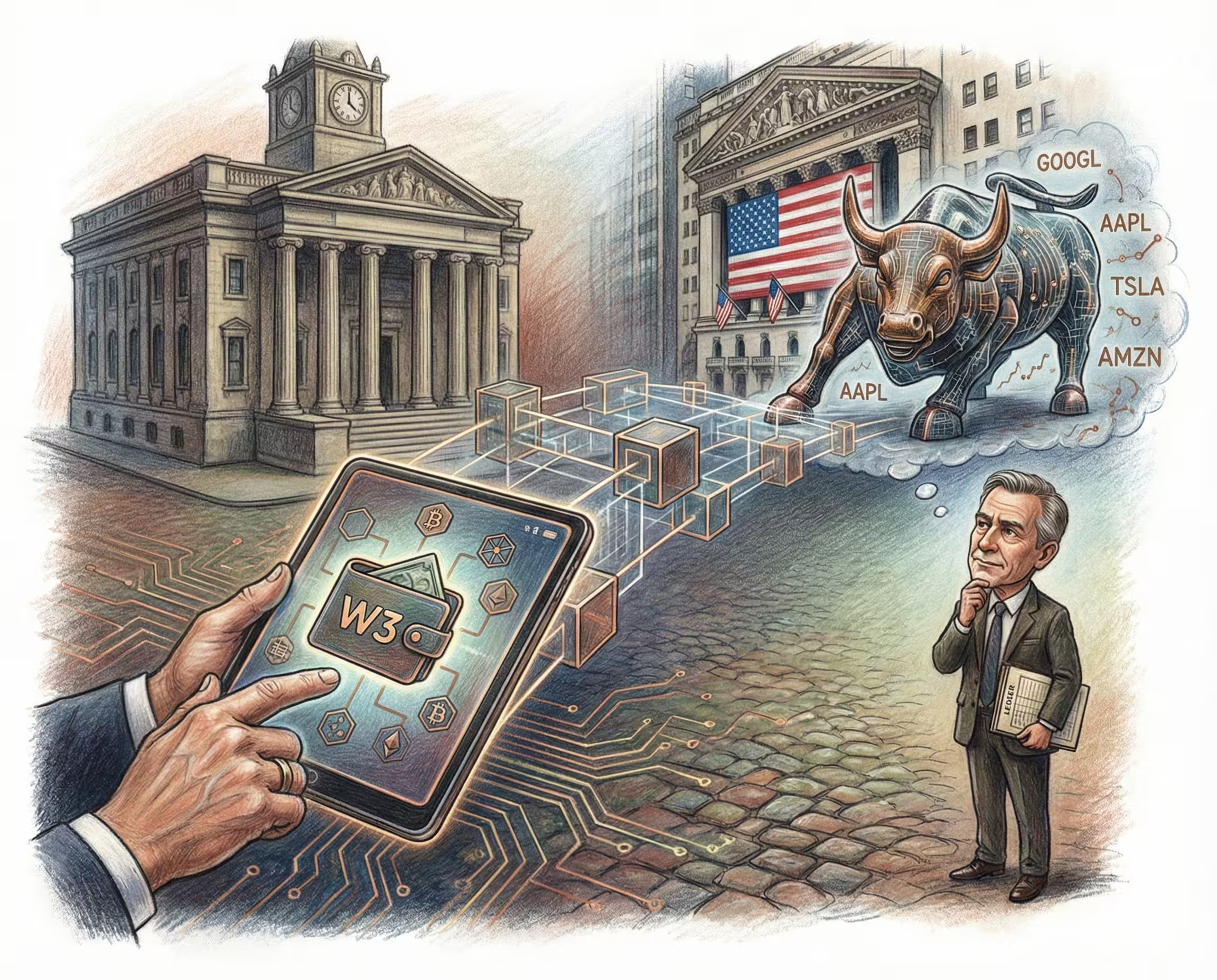
As of February 3, 2026; the integration of MetaMask and Ondo Global Markets fundamentally alters this paradigm. MetaMask is no longer just a wallet. It has evolved into a Hybrid Investment Terminal.
Solving Liquidity Fragmentation
Applying first-principles analysis; this integration solves a critical inefficiency: Liquidity Fragmentation. Historically; a user required a bank account for fiat; a brokerage account for equities; and a Web3 wallet for crypto. These were three distinct silos with three compounding fee layers.
Those barriers are now dismantling. Self-custodial wallets now possess capabilities equivalent to an institutional trading desk. Users can execute swaps from USDC directly into exposure against US mega-caps like Apple or Tesla; all without exiting the Ethereum ecosystem.
The Attack on the Walled Garden
This represents a kinetic strike against the “Walled Garden” business model of legacy banking. If a non-custodial interface can hold Gold (PAXG); Cash (USDC); and Equities (Ondo GM); the bank’s utility as a “wealth gatekeeper” becomes obsolete. For investors in the Global South; traditionally isolated by prohibitive wire transfer fees; this is not merely convenience. It is unprecedented market access.
The Institutional Thesis: Why Consensys Needs Wall Street
Do not assume Consensys (MetaMask’s parent) is acting out of altruism. This is a data-driven calculation. While the crypto market capitalization is significant; it remains a rounding error compared to the $100 Trillion ocean of Traditional Finance (TradFi).
The Growth Saturation Problem
The architects at Consensys recognize a critical metric: User Saturation. Native crypto growth has plateaued. To achieve the next order of magnitude in scaling; the industry cannot rely on memecoin speculation or volatile yield farming. The ecosystem requires assets that are stable; trusted; and globally understood: US Equities and Treasuries.
Joe Lubin’s team is deploying a “Trojan Horse” strategy. By admitting TradFi assets onto Ethereum rails; they effectively position blockchain as the Global Settlement Layer. Every stock purchase executed within MetaMask bypasses Wall Street commissions; instead; it generates gas fees for the network and swap fees for MetaMask. This is a hostile takeover of revenue streams; migrating value from legacy infrastructure to digital rails.
Retail Psychology: The “Super App” Syndrome
From a behavioral finance perspective; we are witnessing a shift from specialization to consolidation. The modern retail investor suffers from “App Fatigue.” Managing capital across local e-wallets; domestic brokerages; and crypto exchanges creates mental friction and capital inefficiency.
Portfolio Convergence
Capital demands Seamless Liquidity. Investors require the agility to capture Bitcoin upside during Asian trading hours and rotate immediately into S&P 500 ETFs during the NY session; all within a single interface.
This drives “Portfolio Convergence.” Digital and physical assets are no longer distinct asset classes in the user’s mind. To the Gen Z and Millennial demographic; 1 Ondo GM Token is as valid as 1 share held at a custodian. The only difference is the ledger: a centralized SQL database versus a transparent global distributed ledger. The market is pricing in efficiency over tradition.
CHAPTER 2: Dismantling the Barriers to Entry
The Anatomy of Global Friction
Theoretically; capitalism promises free markets. In practice; access to high-quality wealth creation instruments—specifically US Equity Markets—is restricted by “Geographic Lotteries.” An investor in Jakarta or Lagos faces friction that a New York resident does not.
Legacy Banking architecture enforces a predator cost structure:
- The SWIFT Tax: The 1973-era messaging system remains the backbone of cross-border settlements. Wire fees ($25-$50) plus FX spreads (1-3%) can erode 30-50% of capital for micro-investors. Their ROI is negative before the market opens.
- Minimum Deposit Gatekeeping: Institutional brokers often mandate $25,000 minimums for international accounts to offset compliance costs. This effectively disqualifies the vast majority of the global middle class.
- KYC Bureaucracy: Legacy verification demands physical documentation often unavailable in developing nations; creating a de facto exclusion zone.
The Cryptographic Solution: Atomic Settlement
The value proposition of the MetaMask/Ondo integration is Atomic Settlement. In TradFi; equity settlement lags by T+1 or T+2 days. On-chain; settlement is finalized within the block time.
Technically; this replaces expensive Correspondent Banking networks with efficient Smart Contracts:
- Bypassing SWIFT: Users swap local crypto assets into USDC; the Ondo contract executes the acquisition.
- Pure Fractionalization: Tokens support 18 decimal places. The concept of “Minimum Lots” is rendered irrelevant. A user can acquire $10 of Berkshire Hathaway (trading at $600,000+) without fractional brokerage premiums.
This aligns with the thesis of “Borderless Capital.” The protocol ignores nationality. It verifies only two variables: Solvency (wallet balance) and Sanctions Screening (OFAC).
The Bear Case: Democratization or Liquidity Extraction?
However; institutional risk analysis requires skepticism. We must look past the “Democratization” narrative and follow the liquidity flows.
The Capital Flight Thesis
When millions of emerging market users rotate from local assets (domestic equities; local bonds) into Tokenized US Treasuries; the macro effect is Capital Flight. Liquidity is siphoned from developing economies to finance US National Debt and inflate US Tech valuations.
Regulatory Arbitrage & Sovereign Risk
There is a profound legal asymmetry:
- The SIPC Illusion: US equity investors are protected by SIPC up to $500,000. Does an Indonesian token holder possess a valid claim against SIPC if the custodian fails? While “Bankruptcy Remote” structures exist; cross-border litigation for retail token holders is a legal impossibility.
- Regulatory Arbitrage: By excluding US persons; Ondo and MetaMask skirt SEC jurisdiction while marketing US securities to global citizens whose local regulators lack the enforcement teeth to police these flows.
We are not witnessing pure financial freedom; we are observing a massive gray zone where technological efficiency outpaces consumer protection frameworks.
CHAPTER 3: Technical Anatomy of Real World Assets (RWA)
The Minting & Redemption Cycle
The true innovation of RWA lies in the backend plumbing; not the UI. Understanding Ondo GM requires dissecting how a digital token forces the movement of a legal entity. This is Legal Transmutation.
The Lifecycle of the Token:
- Liquidity Injection: User deposits USDC into the Ondo Smart Contract.
- The Bridge: The protocol converts USDC to Fiat USD via market makers.
- Custodian Execution: USD is wired to a Qualified Custodian to purchase the underlying asset (e.g.; iShares ETFs).
- Minting: Upon custodial confirmation; the Smart Contract mints the equivalent GM tokens.
Note on Latency: There is a fundamental timing mismatch. Blockchain settles instantly; equity markets settle in T+2. Ondo bridges this gap by providing buffer liquidity; creating an “instant” user experience despite the lethargy of the underlying banking rails.
Asset-Backed Assurance: The Oracle Problem
The claim “1 Token = 1 Share” is dangerous without verification. This introduces The Oracle Problem: Blockchains are blind to the physical world.
Unlike Bitcoin; where truth is endogenous (mathematical); RWA truth is exogenous. Trust is not eliminated; it is shifted.
- Third-Party Audit: Independent auditors verify custodial balances.
- Chainlink Proof of Reserve (PoR): Audit data is fed on-chain via Oracles. If vault assets dip below token circulation; the contract automatically halts minting functions.
This is not a “Trustless” system; it is “Trust-Minimized.” You no longer trust a CEO’s word; but you must trust the Custodian’s integrity; the Auditor’s competence; and the Oracle’s data feed.
Smart Contracts vs. Legal Contracts: The SPV Moat
Many Web3 developers subscribe to the fallacy that “Code is Law.” In the context of RWA; this is fatal. Code is merely the execution tool; the Law is the enforcer.
The most critical component is not the Solidity code; but the corporate structure wrapping it: the Special Purpose Vehicle (SPV).
- Bankruptcy Remote: This is the primary risk mitigant. Client assets are segregated from the operating balance sheet of Ondo Finance.
- The Doomsday Scenario: If Ondo files for insolvency; creditors cannot seize client assets. Those assets belong to the token holders via the Trust.
Without the SPV; a GM token is merely a digital IOU. With the SPV; it becomes a digital certificate of ownership that is—in theory—enforceable in US courts.
CHAPTER 4: Forensics of Failure – Synthetic Illusions vs. Verified Reality
A Comparative Autopsy
To validate the structural integrity of Ondo GM; we must first perform a forensic autopsy on the corpses of the previous cycle: FTX Tokenized Stocks and Mirror Protocol.
The legacy model utilized by these entities was Synthetic Architecture.
- The FTX Case: They marketed “Tesla” tokens to retail. Bankruptcy proceedings revealed the “1:1 Backed” claim was often merely an internal spreadsheet entry. There was no asset segregation. When the exchange collapsed; equity token holders discovered they held “Unsecured Claims” against an empty shell. It was not equity; it was a casino IOU.
- The Mirror Protocol Case (Terra): This relied on algorithmic collateral (LUNA/UST) to mimic US equity price action. When the UST peg disintegrated; the entire synthetic ecosystem evaporated to zero.
The RWA Pivot: Physically Settled
Ondo and MetaMask employ the antithesis of the synthetic model: Physical Settlement.
Tokens do not “mimic” price; they represent title. If Ondo issues 100 GM-TSLA tokens; 100 actual Tesla shares must sit in the custodian’s vault. No algorithm can de-peg because the value is derived from the underlying asset; not the code.
Structural Alpha: Buying the Asset; Not the Bet
For risk managers; the distinction is binary:
- Synthetics (The Bet): You are wagering on price action. If the House (Issuer) fails; the wager is void. The primary risk is Issuer Solvency.
- RWA (The Asset): You own the custody receipt. If the issuer fails; the underlying asset (US Stock) remains legally yours in a bankruptcy-remote vault.
This shifts the risk profile from Algorithmic Market Risk (unpredictable; fatal) to Operational Legal Risk (auditable; manageable). It offers the one thing crypto natives lack: Legal Certainty.
The Centralized Failure Point
However; we must curb the technological euphoria. While RWA solves issuer solvency; it reintroduces the primal risk Bitcoin sought to eliminate: Counterparty Risk.
Smart Contracts cannot audit the physical world; nor can they stop the FBI from seizing a server.
- Custodial Failure: If the Qualified Custodian commits fraud; asset recovery (clawback) through New York courts could take years. An investor in Indonesia effectively becomes a helpless spectator.
- The Kill Switch: US Equities are subject to US jurisdiction. If the OFAC list expands; or a wallet is flagged for suspicious activity (even erroneously); Ondo is legally mandated to freeze the assets.
In DeFi (Uniswap); no one can close your account. In RWA; the “Kill Switch” is real. Owning stock via MetaMask is not “Self-Sovereignty.” It is Hybrid Ownership: You hold the cryptographic key; but the US Government holds the master key.
CHAPTER 5: Liquidity Management in a High-Rate Environment
Converting “Dead Capital” into Yield
In crypto market cycles; the “Crab Market” (sideways action) is a silent killer. When volatility dries up; trillions in capital flee to safety: Stablecoins (USDC/USDT).
There is a fundamental defect in this flight to safety: Opportunity Cost.
Holding USDC in a cold wallet is technically equivalent to stuffing cash under a mattress. The nominal yield is 0%. In a persistent inflationary environment; the real value of that capital erodes every second. This is Dead Capital.
The Institutional Solution
The Ondo integration allows for the instant conversion of Stablecoins (0% Yield) into Tokenized US Treasuries (~4-5% Risk-Free Rate).
- Mechanism: Users swap idle cash exposure for short-term US sovereign debt exposure without off-ramping to a bank.
- Liquidity Profile: Unlike legacy Term Deposits that lock funds for 6-12 months; tokenized treasuries often offer T+0 or T+1 liquidity.
This transforms the wallet from a “Storage Facility” into a “Passive Dividend Engine.” For Smart Money; there is no logical reason to hold zero-yield Cash when Cash Equivalents offer the Risk-Free Rate; unless immediate trade execution is required.
Macro Hedging: The Soft Currency Lifeboat
For investors in “Soft Currency” jurisdictions (Rupiah; Lira; Peso); this utility is a Macroeconomic Hedge.
Holding wealth in local fiat exposes the bearer to a “Double Invisible Tax”:
- Domestic Inflation: Purchasing power erosion.
- FX Depreciation: The collapse of the local currency against the USD.
Tokenized US assets provide a “Two-Step Defense”:
Want Sharper & Deeper Market Analysis?
Get exclusive insights that are logical, comprehensive, and unbiased. Start building your investment strategy based on data, not just assumptions.
- Hard Currency Step: Conversion to USD (Stablecoin) neutralizes FX risk.
- Productive Asset Step: Conversion to Treasuries neutralizes USD inflation risk.
When local central banks fail to contain inflation; frictionless access to US sovereign debt acts as a survival strategy against domestic monetary mismanagement.
The Margin Disruption: Banks vs. Protocols
Let us perform a brutal comparative analysis of capital efficiency. Legacy banking survives on Net Interest Margin (NIM)—the spread between what they pay depositors and what they earn on assets.
- Legacy Bank Scenario: The bank takes your deposit; buys US Treasuries (5% Yield); and pays you 2%. They keep the 3% spread to fund branch real estate and CEO bonuses. Capital Efficiency: Low.
- DeFi/RWA Scenario: The protocol takes your deposit; buys US Treasuries (5% Yield); and passes on 4.5-4.8%. The protocol takes a minimal management fee (0.2-0.5%). Capital Efficiency: High.
This is Margin Disruption. Blockchain removes the bureaucratic middleman eating the spread. However; investors are swapping “Government-Guaranteed Bank Risk” for “Smart Contract & Custodial Risk.” There is no free lunch; only a more mathematically efficient exchange of risk.
CHAPTER 6: Disruption of Time and Capital
The Death of Unit Bias
For a century; capital markets were engineered with an exclusionary assumption: participants are wealthy. This is reflected in “Blue Chip” unit prices. Berkshire Hathaway Class A (BRK.A) trades north of $600,000 per share. Without half a million dollars; access to the world’s premier holding company is blocked.
RWA democratizes access via Decimal Precision.
The ERC-20 standard allows division up to 18 decimal places. A single share can be fractured into 0.000000000000000001 units.
- Portfolio Mathematics: A retail investor with $100 can now construct a portfolio with institutional weighting (e.g.; 40% SPY; 30% QQQ; 20% GLD; 10% TLT). Previously; buying a single unit of SPY (~$500) was mathematically impossible for this demographic.
- True Portability: Unlike Robinhood’s “fractional shares”—which are merely internal ledger entries that cannot be transferred—Tokenized Stocks are portable. You can send 0.05 GM-AAPL to a counterparty in Europe or use it as collateral in a lending protocol. This is Asset Ownership; not a database entry.
24/7 Trading: Eliminating “Gap Risk”
The NYSE/Nasdaq open window (9:30 AM to 4:00 PM ET) covers less than 20% of the week. For the remaining 80%; the market is “Dead.”
This creates Gap Risk.
Scenario: A geopolitical crisis erupts on Saturday. Oil spikes; sentiment collapses.
- TradFi Investors: Locked out. They watch helplessly until Monday’s bell; where they are liquidated at the open (Gap Down). They serve as exit liquidity for institutions.
- RWA Investors: Markets never sleep. If bad news breaks on Saturday; token holders can exit positions immediately.
This integration migrates Price Discovery from Wall Street to the Blockchain. In the near future; Sunday night token prices will serve as the leading indicator for Monday morning’s Wall Street open.
The Arbitrage Mechanism
If the NYSE is closed; what keeps the token price pegged to the stock price?
Incentivized Arbitrage.
The secondary market is governed by rational actors.
- Discount Scenario: Panic selling pushes GM-TSLA to $190 on Sunday; despite a Friday close of $200.
- Arbitrage Action: Bots/Traders buy the discounted asset.
- Redemption: When markets open Monday; they redeem the token for the full underlying value.
This mechanism ensures that even when the parent market is closed; the token price tracks “Perceived Fair Value.” Any deviation is free money for arbitrageurs.
CHAPTER 7: The Geopolitics of Liquidity – A Study in Unregulated Markets
The Global Gray Zone: Why Block the G7?
A profound irony defines the landing pages of Ondo Finance and MetaMask: “Product not available in the US, UK, and Canada.”
Why is a product that deifies American assets prohibited for American citizens? The answer is Regulatory Arbitrage.
Institutions like Ondo do not geoblock the US out of malice; they do so out of fear of the SEC. Under US Federal Law; offering unregistered securities constitutes a felony. Consequently; the strategy is to export that risk to “soft” jurisdictions where legal frameworks lag behind cryptographic innovation.
We are witnessing “Risk Offshoring.”
Emerging markets serve as the experimental petri dish. If the product implodes; the casualties are not voters in a US Congressional district; but retail investors in Asia; Africa; and Latin America. This is a cold geopolitical calculation: extract global liquidity while reserving strict consumer protections for the G7.
Case Study: The Emerging Market “No-Man’s Land”
To understand the legal exposure; we use Indonesia as a proxy for the broader Emerging Market landscape. Where does the GM Token sit within this legal framework? The answer: A Legal No-Man’s Land.
- Not Pure Crypto: Local regulators (like Bappebti) treat crypto as commodities. However; tokens with security characteristics (Security Tokens) rarely make the “Positive List” as they encroach on securities law.
- Not Registered Securities: If viewed as equities; the offering requires Securities Commission (OJK) approval. Soliciting public investment without a prospectus is technically an Illegal Offering.
The Enforcement Void
Global platforms operate on the cloud; beyond the physical reach of local law enforcement. For the user; participation is strictly “At Your Own Risk.” If fraud occurs; local regulators lack the jurisdiction to assist in asset recovery. You are transacting in a sophisticated digital shadow market.
User Compliance Risk: The VPN Trap
Many sophisticated investors attempt to bypass Geo-blocking via VPNs. In pure DeFi (Uniswap); this works. In RWA (Real World Assets); this is Financial Suicide.
Ondo GM and MetaMask employ institutional-grade KYC/AML standards.
- Anomaly Detection: If a user registers with an Indonesian ID but the IP address resolves to a Singaporean Data Center; the compliance engine flags the account as “High Risk.”
- The Blacklist Function: Unlike Bitcoin; GM Tokens and USDC possess Contract-Level Blacklisting. Issuers are legally mandated to freeze wallets violating Terms of Service; including location spoofing.
The Nightmare Scenario: You acquire $10,000 in tokens via VPN. Upon redemption a year later; the protocol triggers a Re-KYC check or detects data inconsistencies. Your wallet is blacklisted. The tokens remain visible on-screen; but their value is zero because they are non-transferable. In the world of RWA: “Not Your Compliance; Not Your Coins.”
CHAPTER 8: The Centralization Paradox
The Theater of Decentralization
A glaring oxymoron sits at the heart of the RWA narrative: We utilize technology designed to remove intermediaries (Blockchain) to distribute assets entirely dependent on intermediaries (Stocks/Bonds).
Philosophically; this betrays the Cypherpunk ethos.
- Endogenous Assets (BTC/ETH): Value comes from within the network. No CEO; no HQ; uncensorable.
- Exogenous Assets (Ondo GM): Value comes from outside the network. The token is merely a digital shadow of a physical asset controlled by humans in a New York office.
Critics label this “On-Chain TradFi.” Blockchain is demoted from a “Sovereignty Layer” to a mere “Settlement Layer.” We are not decentralizing the asset; we are only decentralizing access. The power structure remains a pyramid; with the Issuer at the apex holding total control over reality.
The Admin Key: Revocable Sovereignty
The sacred crypto mantra “Not Your Keys; Not Your Coins” does not apply in RWA.
Holding the private key to a Tokenized Stock only grants access; not absolute ownership.
Embedded within these Smart Contracts are administrative functions known as Admin Keys. These are legal backdoors allowing issuers to execute “God Mode” commands:
- Freeze: Locking a specific wallet address.
- Clawback/Wipe: In extreme cases (court orders/money laundering); issuers can forcibly burn tokens from a user’s wallet and re-mint them elsewhere. Digital seizure.
- Pause Contract: Halting all global transfers in the event of a hack.
When you hold Ondo GM; you are not a “Sovereign Owner”; you remain a “Tenant” subject to the landlord’s permission. For institutions; this is a mandatory safety feature. For decentralization purists; it is a fatal bug that returns us to the legacy banking model; just with a slower; more expensive database.
CHAPTER 9: The Financial “Super App” Convergence
Vision of the Single Dashboard
Historically; finance was segregated. Gold sat in vaults; stocks in brokerage accounts; crypto in Web3 wallets. Each had distinct logins; interfaces; and firewalls.
The MetaMask-Ondo integration signals Asset Singularity.
In this paradigm; the wallet becomes an “Agnostic Container.” To the protocol; there is no difference between Bitcoin (Digital Gold); USDC (Digital Dollar); or GM Tokens (Digital Equity). They are all standardized code (ERC-20) coexisting on a single hexadecimal address.
Capital Interoperability
Imagine using dividends from Coca-Cola (GM Token) to provide liquidity on Uniswap; or using Gold (PAXG) as collateral on Aave to buy the dip on Bitcoin. This level of capital efficiency is impossible in legacy banking; where cross-asset transfers take days and incur multiple fees.
The Existential Threat to Middlemen
If Web3 wallets provide direct access to global capital markets; what is the future of local brokers and domestic mutual fund apps?
They face Total Disintermediation.
The local broker business model is essentially a “Toll Booth.” They charge fees because they hold a license the public lacks. Tokenization renders that license technically irrelevant.
- Competitive Erosion: MetaMask now offers a UI equivalent to local apps but with global inventory.
- Margin Cannibalization: Local brokers charge commissions. DeFi compresses fees toward zero (network cost only).
Unless local apps evolve into “DeFi Gateways” or offer premium advisory services; they will become “Dumb Pipes”—infrastructure bypassed by users seeking direct liquidity in New York.
The Institutional Response: Co-optation
Financial giants (BlackRock; JP Morgan) are not idling. They observe the liquidity migration. Their response is not to ban the tech; but to Co-opt it.
The Walled Garden On-Chain
Observe BlackRock’s BUIDL fund on Ethereum. The future scenario is not “Banks vs. Crypto”; it is “Banks on top of Crypto.”
- The Takeover: Major institutions will launch proprietary custodial wallets integrated with digital identity. They will offer the convenience of Ondo GM but with full legal protection and insurance—on the condition that you surrender your private keys.
- The Custody War: The next battle is not about what you buy; but who holds the keys. MetaMask represents Self-Custody; Banks represent Institutional Custody.
Convergence is inevitable. TradFi needs the 24/7 efficiency of DeFi; DeFi needs the high-quality assets of TradFi. The result is a hybrid system where blockchain becomes the standard backend for global capital markets.
CHAPTER 10: The Endgame – Innovation vs. Compliance
We stand at a historical juncture. This integration is the opening salvo in the war for 21st-century capital market infrastructure. We map two potential futures based on Game Theory between tech innovators and regulatory gatekeepers.
The Bull Case: Capitalism Without Passports
In the optimal timeline; technology forces regulatory adaptation. We achieve the “Internet of Value.”
- Thermodynamic Efficiency: Friction in global capital movement drops to near zero. A coffee farmer in Sumatra saves surplus yield in Tokenized US Treasuries via mobile phone.
- Asset Meritocracy: Capital flows based on asset quality; not geography. Strong companies in emerging markets raise global funding instantly via tokenized securities; bypassing predatory local banks.
The Bear Case: The Balkanization of Liquidity
However; never underestimate the survival instinct of the Nation-State. Governments may view RWA as an existential threat to Monetary Sovereignty.
- The Splinternet: The internet fractures. The US operates “US-Chain”; incompatible with “China-Chain” or “EU-Chain.” Liquidity re-fragments along geopolitical lines.
- Regulatory Capture: Big Banks lobby to strangle open protocols under the guise of “National Security”; replacing them with high-fee private chains.
- The Surveillance State: Because every RWA token has a freeze function; governments can extinguish the financial wealth of political dissidents with a single button press.
Final Thesis: Be the Architect; Not the Victim
As the editorial stance of Corequil.com; we conclude: Understand the Tech; Respect the Jurisdiction.
For global readers; this report is a blueprint of the future; not immediate investment advice.
- Don’t Be the Beta Tester: Let citizens in sanctioned “Sandbox Jurisdictions” test the system reliability. Do not risk using VPNs for products where no local legal recourse exists.
- Compliance is Security: In the centralized RWA world; legal compliance is the Second Private Key. Without it; your digital assets are merely pixels on a screen subject to deletion.
The revolution is real; but so are the casualties. Ensure you are on the side of history that studies the map before stepping into the minefield.
Disclaimer: The content provided by corequil.com is for information and education purposes only and is not intended as investment or financial advice. Please do your own research (DYOR) as your actions are your own responsibility. Check the Terms and Conditions for more information.